
To increase the adoption of continuous manufacturing, particularly for tablet compression applications, GEA and Hovione have been working together to overcome these hurdles and demonstrate how solutions such as SimpleCT can accelerate development, provide greater flexibility and simplify production. Manufacturing Chemist spoke to Anthony Tantuccio (pictured), Fellow Scientist, Continuous Tableting/Technology Intensification at Hovione, to find out more.

Continuous manufacturing (CM) solutions can accelerate product development, reduce costs, improve operational economics and make production more agile with less downtime. With advanced controls and tightly linked process data to product output, it enables more consistent tablet quality. “It’s a more efficient and flexible mode of manufacturing,” notes Tantuccio, “offering consistent and reliable tablet production with fewer operators and less waste of precious active pharmaceutical ingredients (APIs) and raw materials.”
“Yet,” he adds, “running a continuous direct compression (CDC) line during development can often be a daunting task.” Any inherent complexity stems from managing parallel, integrated operations that all occur at the same time (as opposed to a single unit operation). “Even relatively straightforward duties — such as collecting samples, changing process conditions or running Residence Time Distribution (RTD) tests — can become multi-person activities with a high potential for error.”
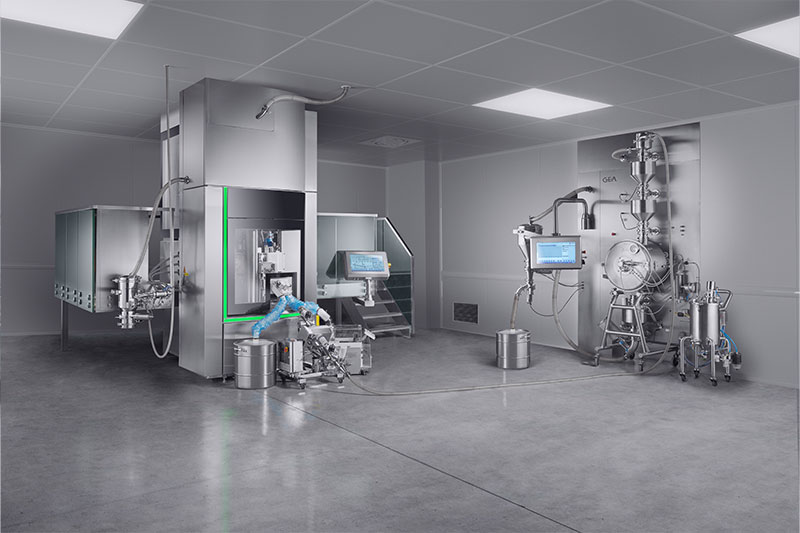
SimpleCT focuses on simplifying these development-critical tasks, not by removing flexibility but by embedding automation, structure and guidance directly into the equipment and control systems. The result is a toolset designed for how R&D teams develop continuous tableting — mapping a design space and generating calibration samples within a single run — while reducing manual co-ordination and increasing confidence in the data generated. “Rather than treating continuous development as a scaled-down version of commercial manufacturing,” explains Tantuccio, “SimpleCT recognises that development has different priorities: rapid learning, efficient experimentation and robust process insight.”
Accelerating development cycles and time to market
One of the most immediate benefits of SimpleCT for R&D teams is speed. Development programmes on continuous lines can be significantly shortened when routine yet complex tasks are automated and synchronised across the system. “During many development scenarios,” says Tantuccio, “Design of Experiments (DoE) execution remains largely manual and labour-intensive — introducing inefficiencies, safety risks and data variability at a time when consistency and speed are paramount.”
Tools such as assisted DoE (ADoE) allow development steps to be predefined and executed automatically. Instead of manually adjusting dozens of parameters under time pressure, operators can progress through experimental conditions in a controlled and repeatable way. This reduces the setup time between experiments and minimises the risk of incorrect parameter entries or missed steps.
“Shorter development cycles translate directly into faster decision-making and earlier progression to clinical or commercial stages,” adds Tantuccio: “Even a modest reduction in development time — measured in weeks or months — can have a meaningful impact on time-to-market and overall project value. Furthermore, unrealised capacity can become available.”
Speed alone is not enough, though; R&D teams also need confidence in their understanding of the process. SimpleCT enhances operational insight by improving how information is presented and captured during development. More detailed screens, clearer alarm messages and time-aligned datasets help operators to understand not just that something has happened … but why it happened.
At the core of SimpleCT is the ability to define and execute multivariate experiments within clearly defined operating ranges by a single person.
Reducing reliance on specialised personnel
Traditional continuous development often assumes the availability of highly experienced operators or process engineers who can manage simultaneous set-point changes, sampling schedules, data alignment and troubleshooting in real-time. In practice, this creates a bottleneck: development becomes dependent on a small number of experts.
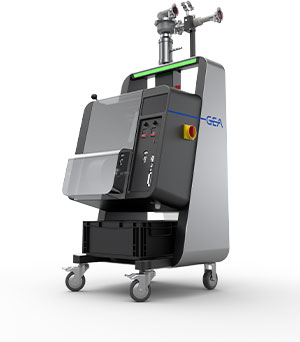
“SimpleCT is designed to lower that dependency,” suggests Tantuccio. “Automated sampling systems, guided workflows and more informative operator interfaces allow development activities to be done by fewer people with less reliance on niche expertise. For example, automated tablet sampling systems can collect, bag, label and link samples to their respective process conditions at high frequency without manual coordination and management.”
Similarly, automated residence mass collection enables system measurement of how much material is present in the blender during steady operation — a standard requirement for understanding mixing behaviour — and time-aligned data capture at the touch of a button. Tasks that previously required multiple operators working closely together can now be performed safely and consistently by a single trained user. “This reduction in headcount pressure is particularly valuable in R&D environments when resources are limited and teams are balancing multiple programmes simultaneously,” Tantuccio adds.
Improving process insight during development
Manual “spiking” operations have historically posed safety and operational concerns. Spiking involves adding a tracer powder to the process and monitoring its passage through the system, enabling mapping of residence time and identification of key process dynamic behaviour.
These activities frequently require operators to work in proximity to moving equipment and APIs, sometimes under time pressure. Clear communication between the operators responsible for spiking, sample collection and human–machine interface (HMI) adjustments is essential, yet even minor misalignments can compromise data integrity or create safety risks. “As the number of experimental runs increases, so too does the likelihood of human error, mislabelling or incomplete data capture,” comments Tantuccio.
Automated RTD tools, such as contained automatic spiking (CAS) systems, ensure accurate timing, consistent spike introduction and full time-alignment between process data and experimental events. This removes a common source of uncertainty in RTD studies and allows teams to focus on interpreting results rather than questioning data quality. “By reducing manual steps and human error, SimpleCT supports smoother experimentation and faster learning — enabling teams to identify operating windows, sensitivities and transfer risks earlier in development.”
A pragmatic path to continuous adoption
“Importantly,” enthuses Tantuccio, “SimpleCT is not positioned as a radical departure from existing development practices. It is a pragmatic, application-based enabler for teams that already see the value of CM but have hesitated because of its perceived operational complexity.”
The SimpleCT toolset integrates across GEA’s continuous ecosystem — including CDC and related technologies. This lowers the psychological and operational barrier to entry, making continuous development feel manageable rather than overwhelming. “For many pharmaceutical organisations, this derisking effect is just as important as speed or efficiency. By simplifying day-to-day development activities, SimpleCT allows teams to build confidence in continuous tableting early, thereby creating a stronger foundation for later development stages and commercialisation,” Tantuccio adds.
From complexity to confidence
The take-home message from Tantuccio is that continuous manufacturing doesn’t need to be complicated to be powerful. “For R&D teams, the real challenge has never been understanding the theory; it’s been managing the practical realities of development on integrated, all-at-once and always-on systems.” By removing manual handling and co-ordination from critical development steps, SimpleCT from GEA and Hovione delivers tangible benefits in three key areas: reliability, ease of operation and data assurance. Automation minimises the risk of human error for standardised workflows, whereas push-button execution allows complex multivariate experiments to be done efficiently and safely.
The quality and consistency of the data generated provide a strong foundation for process understanding, supporting faster decision-making and more robust commercialization activities. By automating complex tasks, reducing headcount requirements and improving process insights, SimpleCT enables faster, more confident development on continuous lines. “For teams ready to move beyond batch — but looking for a simpler way forward — continuous has just become easier,” concludes Tantuccio. “With SimpleCT, you can take the complexity out of continuous development and get to market even faster.”
SimpleCT: accelerating time-to-market
In an increasingly competitive landscape, the ability to develop and optimise tablet formulations quickly can provide a decisive advantage. Part of GEA’s ConsiGma® portfolio, SimpleCT supports the faster development of direct compression products, reduces material consumption during experimentation and shortens overall time-to-market. At the same time, improved operator safety and reduced exposure to APIs align with the industry’s ongoing focus on sustainable and responsible manufacturing practices.