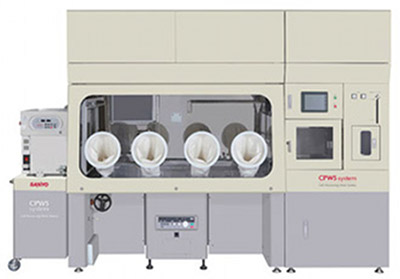
To be used to advance stem cell and cell therapy research at the University of Alabama at Birmingham
The Biomedical Solutions division of Sanyo North America Corporation has installed its Cell Processing Work Station (CPWS), an integrated, stand-alone system for GMP compliant processing and preparation of regenerative stem cell and cell therapies for research use, at the University of Alabama at Birmingham (UAB).
Sanyo, based in Woodvale, Illinois, says this is the first installation of the CPWS in the US, and the first outside Japan.
The workstation provides the required class-100 aseptic environment in a compact footprint and at a lower cost than a traditional cleanroom, the company says.
The CPWS installed at the university is a positive pressure system, which will aid the school in its research into gene and cellular therapies. A negative pressure CPWS is in development.
The small footprint of the CPWS allows installation into existing or new lab spaces using conventional utilities and minimal site preparation. Offering an efficient operational capacity, the workstation also includes GMP-compliant equipment for aseptic processing and provides user-friendly operation controls.
As well as requiring lower capital costs, the Sanyo CPWS also saves approximately 35% of the operating costs usually required for conventional cleanroom environments.
Sanyo expects the CPWS to make a significant contribution to advancing research in the cell therapy market. Current and future applications of the CPWS include preclinical regenerative cell therapy research for organ and tissue repair and immunotherapies for treating cancer. Additional opportunities for the CPWS include the pharmaceutical bioprocessing market.
The University of Alabama will use the CPWS to manufacture induced pluripotent stem (iPS) cells and gamma-delta T cells for research use. The iPS cells will be studied as a cure for sickle cell anaemia, while Gamma-delta T cells will be studied for treating cancer.
“The CPWS allows seamless preparation of cell and gene therapy products in a totally contained temperature controlled aseptic environment, drastically reducing the risk of microbial contamination,” said Larry Lamb, director of the UAB Cell Therapy Lab, which houses the Sanyo CPWS.
“The technology also has the ability to change over the entire system in 90 minutes allowing for multiple cell products to be produced in a single CPWS.”