

Amazon has announced the launch of Amazon Bio Discovery, a new AI-powered application it says is designed to help researchers "design and test novel drugs more quickly and confidently."
Amazon Bio Discovery will offer scientists access to specialised AI models called biological foundation models (bioFMs) trained on large biological datasets.
These models help generate and evaluate potential drug candidates, speeding up the development of antibody therapies in the early stages of drug discovery.
With the new platform, researchers can interact naturally with an AI agent that automates complex tasks, allowing them to choose the right models, optimise inputs and evaluate candidates. They can also use their previous experimental data to improve predictions and easily send candidates to labs for synthesis and testing, facilitating rapid iterations in the research process.
Recent advancements in generative AI have led to a surge in machine learning models for tasks such as predicting protein structures and evaluating chemical candidates.
However, these models often require coding skills and complex computing infrastructure, making independent use challenging for many scientists. Additionally, the overwhelming number of models complicates effective benchmarking.
Amazon highlights the struggle scientists face due to the scarcity of computational biologists who possess the necessary AI expertise. Moreover, transitioning from computational design to physical synthesis is difficult, as data is often disconnected, requiring coordination among multiple lab partners.
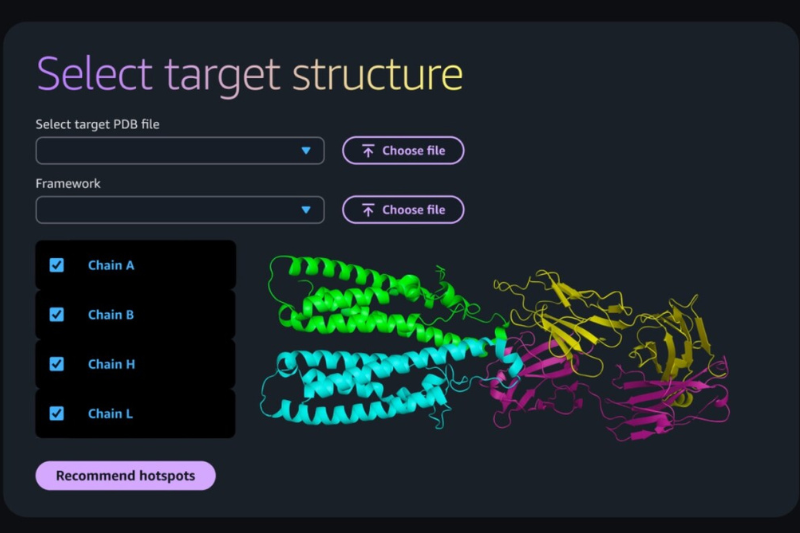 To tackle these issues, Amazon Bio Discovery provides the following three main features:
- a benchmarked library of AI models
- an AI agent to assist in experiment design
- and integrated lab partners that test promising antibody candidates and return results.
This creates a helpful feedback loop for improving future designs.
"AI agents make powerful scientific capabilities accessible to all drug researchers, not just those with computational expertise," said Rajiv Chopra, Vice President of AWS Healthcare AI and Life Sciences.
"These AI systems can help scientists design drug molecules, coordinate testing, learn from results and get smarter with each experiment."
This combination of cutting-edge AI and the robust, secure infrastructure AWS has built for regulated industries allows scientists to accelerate antibody discovery in ways that weren't possible before.
The company says the new platform builds on a trusted foundation, with 19 of the top 20 global pharmaceutical companies already using AWS to power sensitive research workloads.
Amazon Bio Discovery will also provide complete data isolation and give customers ownership of all their proprietary data and intellectual property.
Using AI in research with ease and confidence
Amazon added in its announcement that the new Amazon Bio Discovery will provide scientists with a wide array of AI models for drug discovery, including open-source and commercial options from partners such as Apheris and Boltz, with more models from Biohub and Profluent on the way.
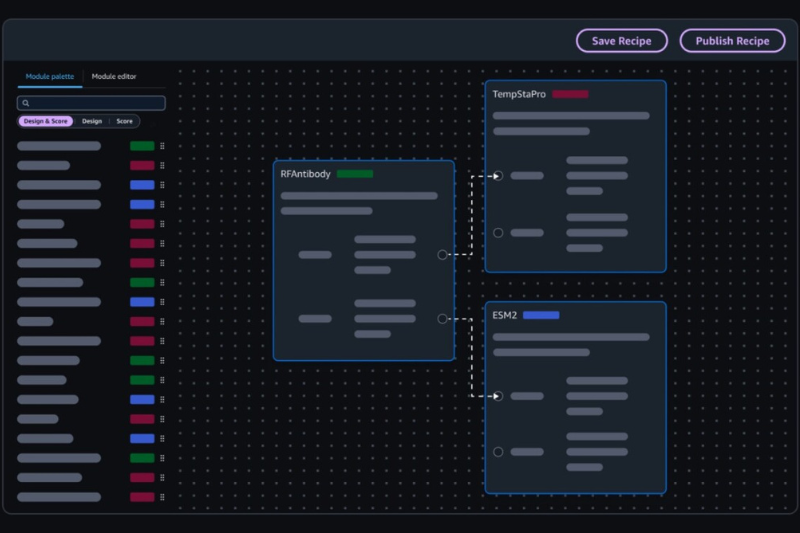
An AI agent will assist scientists in designing experiments and selecting promising candidates for lab testing. Using natural language, scientists can create experiment recipes — step-by-step workflows combining various models. They can also benchmark model effectiveness based on their research needs.
Additionally, a growing antibody benchmark dataset helps evaluate the manufacturability, stability and biological suitability of drug candidates.
Improve AI models with prior experimental data
The new AI platform will also eliminate the need for dedicated machine learning teams and expensive infrastructure for fine-tuning proprietary data. Instead, it will enable scientists to securely feed prior experimental data from their organisation's lab results into the application, with the company stating "they can use their own lab data to train custom models with just a few clicks — no need to build complex training pipelines or write custom code."
 All fine-tuned models would remain private and accessible only to the user or their organisation.
Once scientists identify top antibody candidates, they send them to Amazon Bio Discovery's lab partners — Twist Bioscience and Ginkgo Bioworks, with A-Alpha Bio joining soon — for synthesis and testing.
These partners offer clear pricing and turnaround times, providing crucial data to help scientists select candidates for further development.
Lab results would then be integrated back into the organisation's system, maintaining data connectivity and improving the design cycle. This application replaces manual hand-offs and disconnected systems, effectively closing the experimental loop.
Designing novel antibodies with Memorial Sloan Kettering Cancer Center
Dr Nai-Kong Cheung, the Enid A. Haupt Chair in Paediatric Oncology at Memorial Sloan Kettering Cancer Center (MSK), faced a challenge in cancer research: the lengthy process of developing antibody drug candidates.
In collaboration with the Amazon Bio Discovery team, Cheung utilised innovative technology to design nearly 300,000 novel antibody molecules. They selected the top 100,000 candidates for testing at Twist Bioscience. This entire process, which typically takes a year, was completed in just a few weeks.
"We're glad to be able to join forces with Amazon Bio Discovery to develop the next generation of antibodies that will potentially speed up the process to help patients worldwide," said Cheung.
As researchers, we spent 20 years just to prove that the first generation of antibody worked and then we spent another 13 years getting it into the human form before getting FDA approval.
"This path has been very inefficient. Patients come here with a clock. We need results sooner."
In addition to MSK, Bayer, the Broad Institute, Fred Hutch Cancer Center and Voyager Therapeutics are among early adopters using Amazon Bio Discovery.


