Drying is a particularly complex and time-intensive stage in chemical manufacturing, presenting a major bottleneck in overall process cycle time. To ensure scale-up success, early R&D must prioritise precision and data reliability. Highly automated workflows are increasingly ideal for reproducibility and seamless technology transfer. Since drying defines key physical attributes of an active pharmaceutical ingredient (API), precise control during this phase safeguards product quality and performance.
Scale-Up Challenges
Variability in batch outcomes commonly stems from human error or non-standardised procedures. Manual operations struggle to achieve consistent results, making scale-up predictions uncertain. Drying processes, in particular, involve intricate interactions between material properties, vapour-liquid balance, and equipment-dependent parameters. In API manufacture, agitated contact drying under vacuum is widely used for granular materials, and advanced automation provides a pathway to greater repeatability, predictability, and scientific understanding of these critical processes.
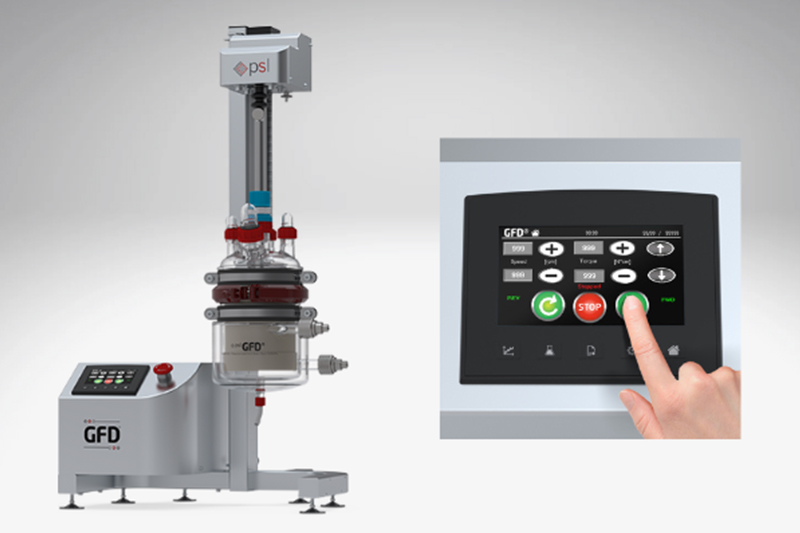
Recipe Automation with GFD®Lab PLUS
The GFD®Lab PLUS is a digital “smart lab assistant,” designed to streamline process development through automation. As a true laboratory-scale version of a full-sized agitated Nutsche filter-dryer (ANFD), it allows process engineers to design and execute bespoke drying recipes with precision.
Using an intuitive interface, users can pre-program detailed steps such as:
- Agitator Direction
- Agitator Blade Height
- Agitator Speed
- Step Duration
The system enables storage of up to 99 individual recipes, each executed with complete parameter consistency at the touch of a button. This level of automation enhances reproducibility, reduces operator dependency, and provides the data integrity needed for predictive scale-up.
Data Capture and Export
Effective scale-up depends on quantitative insights. The GFD®Lab PLUS not only automates control but also captures and exports key process data for analysis, including temperature and pressure profiles.
Such insight supports data-driven decision-making during process transfer. Notably, research shows that headspace pressure often exerts the most influence on residual solvent levels, highlighting the need for comprehensive, real-time monitoring. Detailed data capture also strengthens Quality by Design (QbD) documentation, technology transfer protocols, and regulatory submissions.
Ensuring Batch Repeatability
Automation ensures every batch follows the same operational sequence, minimising variation and reducing human error. The GFD®Lab PLUS is engineered to deliver high repeatability across multiple runs, instilling confidence in process robustness. Consistent laboratory results translate into smoother transitions from R&D to pilot and production scales.
Agitation control is especially important: speed directly affects particle morphology.
- Low stirring speeds can cause agglomeration.
- Excessive speeds can lead to attrition and breakage.
Another key variable is the critical moisture content (CMC), also known as the “sticky point.” At this solvent level, agitation can promote unwanted granulation or hard lump formation. The GFD®Lab PLUS allows precise control over agitation parameters, drying progression, and drying progression, protecting particle integrity while optimising efficiency.
Interested in Scale-up Solutions?
Automation in laboratory filtration and drying, powered by programmable recipes, precise control, and comprehensive data logging, is accelerating the path to production. The GFD®Lab PLUS transforms complex, variable processes into predictable, data-rich workflows that accelerate development and improve confidence in scale-up. With accurate data and repeatable performance, process engineers can achieve fit-for-purpose predictions up to industrial scales of 1000 kg or more.