
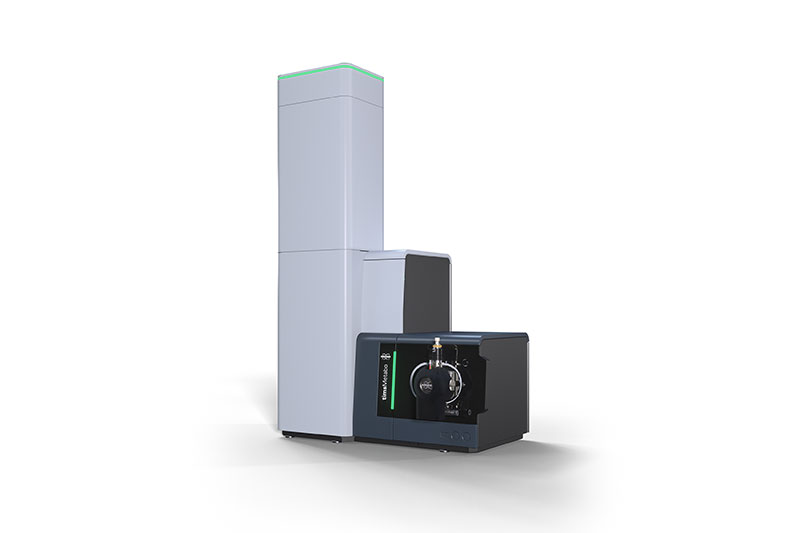
At ASMS, Bruker Corporation (Nasdaq: BRKR) announced the launch of the unique timsMRMS system, bringing the power of trapped ion mobility separation to ultra-high-resolution magnetic resonance mass spectrometry (MRMS).
A translational oncology research initiative by Prof. Stephan Singer at University Hospital Tübingen enables therapy selection, measuring more than 10,000 proteins in FFPE biopsies to reveal actionable tumour biology when precision genomics is inconclusive.
Major timsUltra AIP and further timsOmni advances, razor-PASEF workflows, Spectronaut 21 and OmniScape software advance proteomics to >10,000 proteins per sample, more than 6,500 proteins at 500 samples per day (SPD), and make sensitive and information-rich top-down characterisation 4x more sensitive for proteoforms, antibodies, glycoproteins, oligonucleotides.
Frank H. Laukien, PhD, Bruker’s President and CEO, said: "Proteoforms are the fundamental unit of molecular disease. A single gene encodes one protein group but can give rise to over 50 protein variants through genetic variation, alternative splicing, post-translational modifications and protein processing. From just 20,000 human genes, these biological processes generate more than one million distinct functional – and sometimes pathological – human proteoforms."
He continued: "The revolutionary timsOmni combines trapped ion mobility and trapped ExD technologies to give scientists higher dimensionality, unmatched top-down sensitivity and information-rich structural information for deeper insights. The unique OmniScape AI-driven top-down software transforms this biological complexity into clarity and insights. Deep functional proteoform analysis can now compress the path from discovery to biomarkers, precision medicine and novel therapies. We have entered the era of deep, differentiated proteoform structural variant analysis for functional proteomics 2.0 at scale, with profound benefits for a much deeper understanding of the molecular drivers of disease. This opens an unprecedented opportunity to accelerate drug discovery with meaningfully higher drug candidate success rates in humans."


