Mass flow metering and control specialist Bronkhorst, based in Cambridgeshire, UK, is offering an alternative to the gravimetric or weighing scale method of dosing additives, which promises shorter processing times, better product results and improved working atmospheres.
Mass flow metering and control specialist Bronkhorst, based in Cambridgeshire, UK, is offering an alternative to the gravimetric or weighing scale method of dosing additives, which promises shorter processing times, better product results and improved working atmospheres.
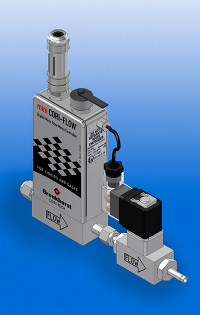
The company's Cori-Fill compact fluid dosage assembly, which combines a Cori-Flow or mini Cori-Flow flowmeter with a suitable valve or pump, is capable of dosing the exact amount of fluid, while multiple instruments can be used for the simultaneous dosing of compounds.
The instrument is suitable for batching, blending, dosing, filling and sterilisation applications at flow rates between 0.4g/hr and 600kg/hr. Aimed at the pharmaceutical, chemical and life sciences industries, among others, it takes up little room and requires no complex programming of additional hardware.
Unlike the conventional gravimetric method of dosing, which uses a shut-off valve and a weighing scale located under the valve's outlet nozzle, the Cori-Fill technology, with integrated batch counters and the facility to operate shut-off valves, is capable of dosing the precise amount of compound into the collecting vessel, with just a brief reset command to start the next batch.
The company says the Coriolis direct mass measurement method eliminates volumetric variation caused by changing temperatures, viscosities and densities of the ingredients, leading to accurate, repeatable quantities batch after batch.
Cori-Fill assemblies are offered with a choice of Cori-Flow instruments, for flow rates between 20g/hr to 600kg/hr, or the highly compact mini Cori-Flow series, for capacities from 0.4g/hr up to 30kg/hr. Either instrument type can be combined with a shut-off valve, for short batch sequences down to <0.3sec, a proportional valve, for longer dosing times >5 seconds, or a gear pump, for dosing without the need for pressurised vessels.