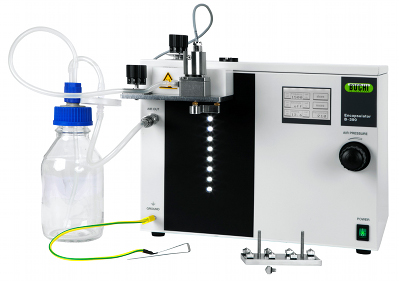
Using the Encapsulator B-390 and B-395 Pro from BUCHI of Switzerland
The Encapsulator B-390 and B-395 Pro made by BUCHI Labortechnik of Switzerland are used for the immobilisation of enzymes, drugs, flavours and fragrances, vitamins, oils, cells or microbes into polymers, such as alginate, carrageen, cellulose sulphate, chitosan, gelatine or pectin, as well as waxes.
Applications range from controlled release and protection systems to coatings of particles with functional groups, improvement of capsule stability, dosage and storage.
Uniform capsules and beads are produced with the same technology, which is based on the principle that a laminar flowing liquid jet breaks up into equally sized droplets by superimposed vibration. The droplet diameter is pre-selectable in the range from 0.15mm to 2mm with a spherical shape and narrow size distribution (< 5% standard deviation).
The clever benchtop design and innovative technology make the Encapsulator B-390 and B-395 Pro especially suitable for the evaluation of encapsulation during the early stages of product development to perform feasibility studies in pharmaceutical and food r&d laboratories and academic research.
Users can benefit from the mild encapsulation conditions, which are suitable for animal cell encapsulation at room temperature and at physiological conditions with full viability of encapsulated living material, reproducible bead formation and real-time process control, sterile handling (autoclavable reaction vessel for sterile containment), user friendliness and wide variety of applications, simple installation, as well as quick and easily learned operation.