
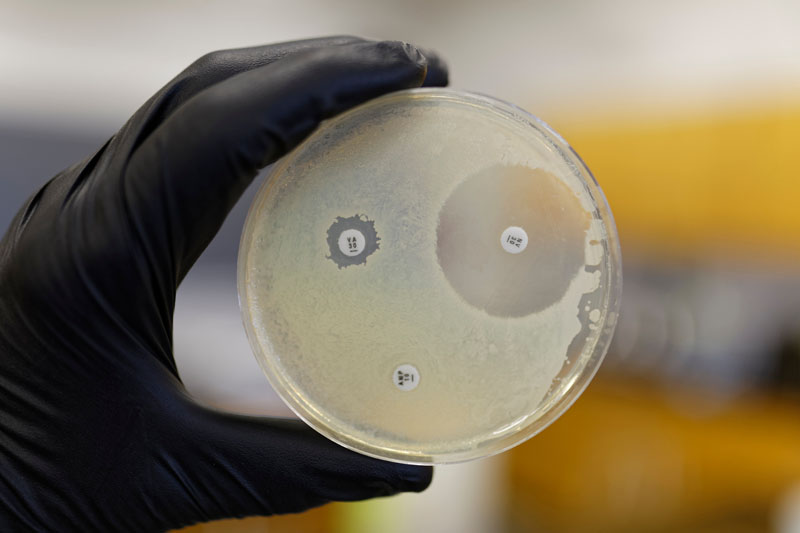
The research, which is published in Science Advances Journal, and led by experts from the Indian Institute of Technology (Mumbai, India), focuses on uncovering the mechanism of antimicrobial resistance (AMR).
Dr Aditi Borkar, Assistant Professor in Molecular Biochemistry & Biophysics in the School of Veterinary Medicine & Science at the University of Nottingham, said: “We have helped researchers at the Indian Institute of Technology, to figure out exactly when and where bacteria modify ribosomes to evade antibiotics such as Erythromycin.”
Bacteria develop resistance to macrolide antibiotics such as Erythromycin, which is used to treat chest infections including pneumonia, skin conditions (acne) and sexually transmitted diseases, by methylating a specific residue in the 23S ribosomal RNA.
In Europe, an estimated 40.7% of Staphylococcus bacteria are resistant to macrolides.
However, the precise stage during ribosome biogenesis and assembly at which this modification occurs was previously unknown.
By combining single-molecule techniques, high-resolution cryo-EM and a cutting-edge mass spectrometry technology called cryogenic OrbiSIMS — a unique imaging capability of the University of Nottingham — the team has pinpointed the exact timing and mechanism of this modification.
These atomic-resolution insights can now inform structure-guided development of next-generation antibiotics.
Dr Borkar explains: “One of the ways that bacteria develop resistance is by modifying their ribosomes. Ribosomes are large molecules with a mass measured in megadaltons (MDa)."
"Ribosomes are so big that they are made up of tens of thousands of atoms. But to become resistant to antibiotics, there are only three additional atoms added into it, so the research team was looking for a three-atom change in this 30/40-thousand-atom molecule."
“We were asked to help visualise these atoms by using our OrbSIMS platform, a powerful method which can provide ultra-high resolution images, and so able to see if and when these additional atoms had been added."
"This technology is unique to Nottingham, and we are delighted that we have been able to contribute to this important and world-changing work.”


