


French biotech Axoltis Pharma has opened its capital to the public as it seeks to accelerate development of its lead drug candidate NX210c in amyotrophic lateral sclerosis (ALS).
The company is currently running a Phase II trial of NX210c, a cyclic peptide aimed at repairing the blood-brain barrier (BBB) — an approach that may be relevant beyond ALS, for neurodegenerative diseases including Alzheimer’s, Parkinson’s and multiple sclerosis.
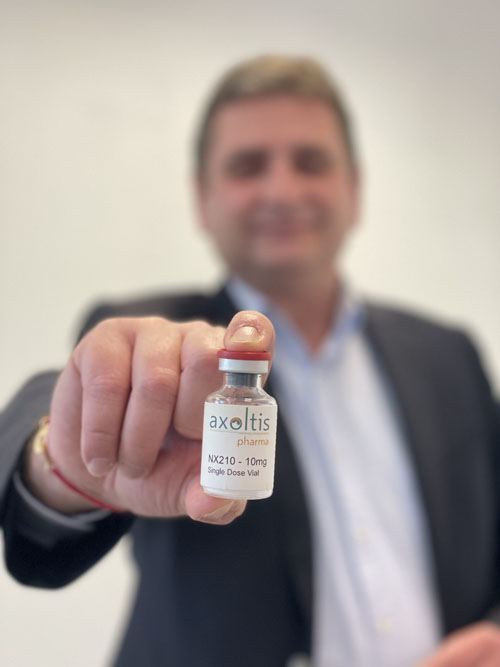
NX210c already cleared Phase Ib testing, in which it showed a favourable safety profile and pharmacological effects.
Biomarker data indicated sustained action on BBB integrity, neuroprotection and neurotransmission pathways.
The Phase II study — named SEALS — is enrolling ALS patients under a protocol authorised by French regulators. Its results, if positive, could mark the first therapy tackling BBB repair in ALS.
By launching a public investment campaign via a crowdfunding-style platform, Axoltis aims to raise funds quickly and broadly — signalling both confidence in NX210c and a readiness to accelerate clinical and manufacturing plans.
In other European biotech news, French oncology start-up BiPER Therapeutics has secured seed funding to push its first-in-class cancer therapy towards the clinic.
BiPER, which is developing a BiP/GRP78 inhibitor (lead candidate BPR001) for gastrointestinal cancers, has raised €1.25m.
The financing comes from a mix of dilutive funding, convertible bonds and grants, including support from the French public-investment bank Bpifrance.
This funding will enable BiPER to progress preclinical development toward a Clinical Trial Application (CTA) or Investigational New Drug (IND) filing, likely for gastric cancer as the first indication.
The company’s approach is ambitious: BPR001 aims to stress cancer cells via endoplasmic-reticulum (ER) stress induction, an original mechanism designed to kill tumour cells — even those resistant to standard therapies.
BiPER has reportedly also raised a further €800,000 in bridge financing to support final regulatory toxicology work ahead of the planned early-phase clinical trials.
Meanwhile, in the medtech space, Dutch company Xeltis has secured nearly €50m to advance its bioresorbable vascular-access conduit aXess toward market launch.
The financing package includes a loan of up to €37.5m from the European Investment Bank (EIB) — via its InvestEU programme — plus €10m from existing shareholders such as EQT Life Sciences and Invest-NL.
The investment follows the publication of positive data from Xeltis’ EU pivotal trial of aXess, showing sustained patency (open vessel), lower infection rates and fewer interventions compared with the standard of care in adults requiring haemodialysis.
A pivotal US trial is also under way with market approval — in Europe and a premarket green light in the US — expected in 2026.
The fresh financing will be deployed to scale-up production, recruit staff, and support the expansion of Xeltis’ broader pipeline of bioresorbable vascular devices, including coronary bypass and other cardiovascular grafts, all built on its proprietary endogenous-tissue restoration (ETR) platform.
Implications for pharma-medtech manufacturing and investment
This wave of funding underscores how investors — both public and private — are backing novel, high-risk/high-reward therapeutic and device platforms, often where unmet medical needs remain large.
For manufacturers and suppliers, this may signal increased demand for GMP-grade peptide synthesis, implantable-device production capacity, polymer-processing technologies and supply chain services across Europe.
In particular:
- if NX210c succeeds, the peptide-therapy sector may see renewed interest from contract manufacturing organisations (CMOs) specialising in complex neuro-peptides
- BiPER’s planned move into clinic could drive demand for GMP-grade small-molecule API manufacturing, formulation and early-phase clinical supply operations
- Xeltis’ scaling of aXess manufacturing could create opportunities for polymer-device subcontractors, sterile manufacturing plant and supply chain support for distributors of vascular grafts.
Together, these developments suggest a burgeoning market for manufacturing and supply services that can support next-generation medicine — from first-in-class cancer candidates to regenerative vascular devices and neurotherapeutics targeting previously undruggable pathways.
For the UK — and Europe more broadly — such financing activity may help stabilise and grow a manufacturing infrastructure tailored to advanced therapies, potentially offsetting the outsourcing of manufacturing to other regions.


