
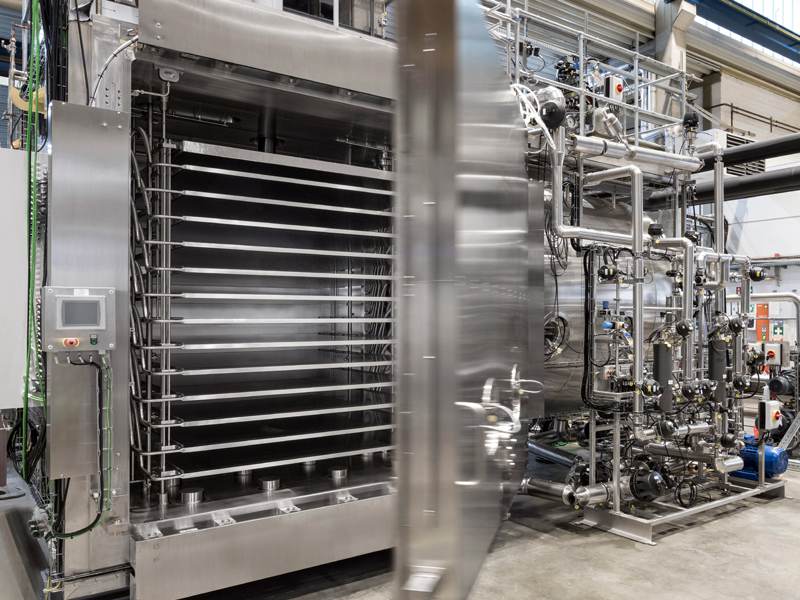
Freeze-drying (lyophilisation) has long been a workhorse technology in pharmaceutical production. And although it is considered to be indispensable when it comes to stabilising biologics, vaccines and sensitive active pharmaceutical ingredients (APIs), it’s also notorious for heavy energy use. GEA’s LYOVAC® ECO Mode, recently covered by Manufacturing Chemist, tackles that problem by rethinking how condensers and valves are controlled during the drying cycle to reduce energy and refrigerant use — all while safeguarding product integrity.1
What is ECO Mode and how does it work?
At its core, LYOVAC® ECO Mode replaces the conventional “fixed cold-wall” approach with a dynamic control strategy. Instead of holding the condenser at a single (very) low temperature throughout the cycle, ECO Mode continuously adapts the condenser set-point to match what the product and process actually require at each stage of drying. Simultaneously, the system modulates the so-called mushroom valve (the chamber–condenser bypass valve) and — optionally — the nitrogen inflow to manage mass transfer and chamber pressure. The combined effect is a process that is “no colder than absolutely necessary,” states Thomas.
This adaptive control is implemented using an algorithm that evaluates process signals (such as pressure rise measurement [PRM] during primary/secondary drying) and adjusts hardware set-points in real-time. Because the condenser and valve work together, ECO Mode can reduce any unnecessary refrigeration load without extending cycle times or compromising endpoint detection.
The benefits: energy, media and process integrity
The headline benefit is reduced energy consumption, emphasises Thomas. GEA and subsequent press coverage describe ECO Mode as delivering “substantial” energy savings and optimising refrigerant usage compared with classic fixed-temperature operation.2 In published communications, adds Thomas, GEA has referenced a figure of “up to 30% energy savings” as an achievable outcome in trials. Although actual savings depend on product, load configuration and local utility structures, the combination of dynamic condenser set-point and valve regulation is consistently presented as an effective route to lower utility demand.2
Crucially for pharmaceutical manufacturers, trials reported by Manufacturing Chemist show that processing times and primary/secondary drying endpoints remain comparable with classic operations when using PRM for endpoint detection. In the examples discussed (including 3% mannitol and 5% sucrose test loads), ECO Mode matched cycle performance while using less cooling power — indicating that energy efficiency gains need not force trade-offs in throughput or product quality.1
Other practical advantages include reduced stress on refrigeration systems (because condensers run at milder temperatures when appropriate), potential reductions in refrigerant charge or replacement frequency, and alignment with wider plant decarbonisation goals — all of which are increasingly relevant as firms set Scope 1/2 targets or respond to tightening regulations on greenhouse gases.3
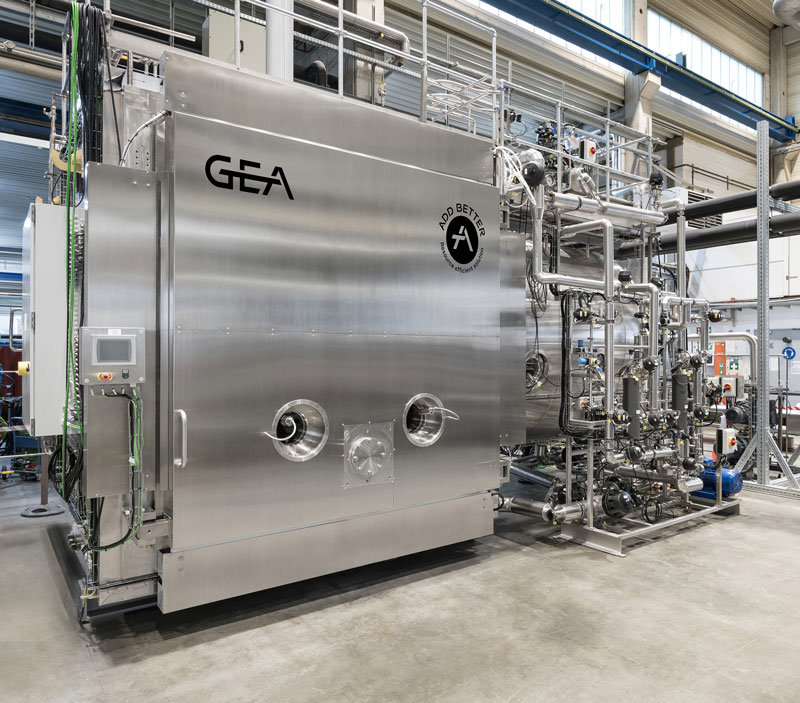
Where ECO Mode fits in a modern lyophiliser infrastructure
LYOVAC® ECO Mode is positioned as a software-driven retrofit-compatible upgrade that’s available for GEA’s industrial LYOVAC® freeze-dryers (from small modules up to large-scale [>1000 kg] production models). Furthermore, it complements other sustainability efforts from GEA — such as the LYOAIR® cooling system that uses natural refrigerants and booster cycles — and can be applied as a “drop-in” improvement for sites looking to extract energy savings from existing process hardware without a major mechanical redesign.4,5
Because ECO Mode uses existing control points (condenser temperature, mushroom valve, nitrogen flow) and process measurements (PRM), it is a pragmatic retrofit or option for new LYOVAC installations. This makes it attractive for companies that want measurable utility reductions while minimising validation overhead, notes Thomas: the control philosophy relies on established process end-point metrics rather than experimental shortcuts.1
Practical considerations for implementation
- Product and cycle dependency: The magnitude of energy savings will vary by formulation, fill volume, tray configuration and cycle design. Formulations with longer sublimation phases or a high condenser load are likely to benefit more. Trial runs under controlled conditions (as reported by GEA) are recommended to quantify savings for a specific product.
- Endpoint strategy: ECO Mode works best when robust endpoint detection methods such as PRM are used so that dynamic control does not compromise the accuracy of primary/secondary drying endpoints. Validation protocols should capture any changes in process performance under dynamic control.
- Integration with plant sustainability plans: ECO Mode is one piece of a broader energy efficiency puzzle. Combining it with efficient chillers, waste-heat recovery, renewable electricity and better scheduling/stacking of batch runs will maximise facility-level gains. GEA positions ECO Mode alongside other product and plant measures as part of a comprehensive decarbonisation roadmap.6
Evidence and real-world data
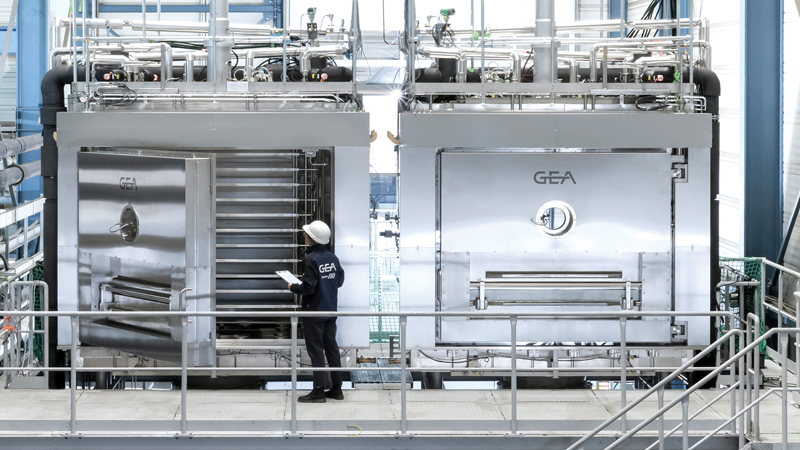
Manufacturing Chemist recently summarised data from trials showing energy use improvements for test loads (mannitol and sucrose formulations) with no appreciable change in processing time — evidence that the dynamic control approach can deliver payback without quality penalty. GEA’s own technical pages and press materials echo these conclusions while framing ECO Mode as part of the LYOVAC® product family and GEA’s sustainability portfolio. For readers considering ECO Mode, the published case examples provide a starting point for expected outcomes but site-specific testing remains essential, advises Thomas.1
Bottom line
LYOVAC® ECO Mode is a thoughtful, control-based step toward making freeze-drying more sustainable. By matching condenser performance to process need and using valve modulation as an additional lever, it reduces unnecessary refrigeration work and can lower energy consumption significantly — up to approximately 30% — while preserving cycle times and product endpoints when validated correctly. For pharmaceutical manufacturers wrestling with energy costs and ESG targets, ECO Mode represents a low-friction, high-impact option to reduce the carbon and cost intensity of lyophilisation.
References
- https://manufacturingchemist.com/improving-the-sustainability-of-pharmaceutical-freeze-drying-with.
- www.gea.com/en/news/trade-press/2024/pharmaceutical-freeze-drying.
- https://manufacturingchemist.com/the-new-f-gas-regulation-and-its-impact.
- https://manufacturingchemist.com/GEA-sustainability-pharmaceutical-freeze-drying-energy-efficiency.
- www.gea.com/en/products/dryers-particle-processing/lyophilizers/lyovac-eco-mode.
- https://manufacturingchemist.com/leading-the-pharmaceutical-market-with-sustainable-innovation.
GEA Lyophil earns Add Better label for sustainable freeze drying
GEA Pharma & Healthcare’s LYOVAC® ECO Mode has been awarded the Add Better ecolabel, validated by TÜV Rheinland, recognising its measurable energy saving benefits in large-scale pharmaceutical freeze-drying. In production-level tests using a LYOVAC® FCM 500-D unit, the technology achieved a 21.1% reduction in electrical power consumption, saving 401 kWh per cycle without affecting product quality. TÜV Rheinland confirmed that GEA’s environmental claims met international standards (DIN EN ISO 14021:2021-10) and were transparent, coherent and independently verifiable.