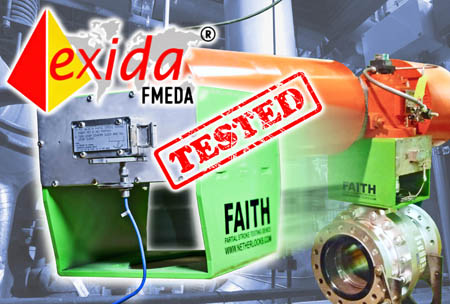
According to FMEDA report by Exida, the Netherlocks partial stoke system FAITH (Fail Action Integrity Test Handling) is very reliable
The FMEDA report showed the Netherlocks partial stoke system FAITH (Fail Action Integrity Test Handling) to be very reliable, with 0 Fail Safe Detected, Fail Safe Undetected and Fail Dangerous Detected conditions recorded from the tests. For most cases, the FAITH is suitable for use in SIL3 applications.
The FAITH system makes it possible to carry out a manually initiated partial stroke test on ESD (Emergency Shut Down) valves during normal operation, without interrupting process flow. It limits, with mechanical stops, the angle of the stroke of the valve-actuator combination to a set percentage – ensuring the ESD valve ‘works’, without actually shutting down the operation. By operating mechanically rather than relying on electronic contacts or signals, reliability and simplicity is maximised.
An FMEDA (Failure Modes, Effects, and Diagnostic Analysis) assessment has been carried out by Exida on Netherlocks’ FAITH system. The product was subject to a thorough examination according to IEC 61508 to determine Probability of Failure on Demand (PFD) statistics for this device. The failure rates of the FAITH System must be added to the failure rates of the valve-actuator combination when determining the PFD AVG and Safe Failure Fraction (SFF) for the final element.
More details, a summary and the report itself are available to customers upon request from sales@netherlocks.com or at www.netherlocks.com.