

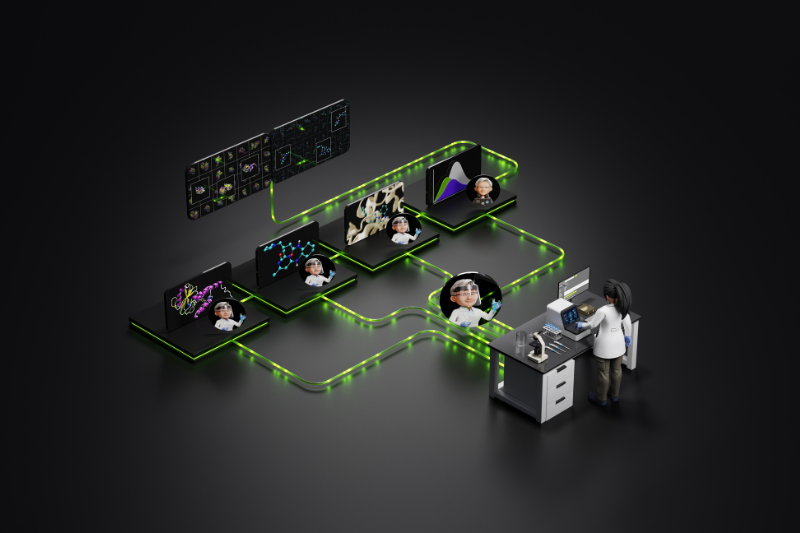
NVIDIA has launched its BioNeMo Agent Toolkit, a suite of domain-specific tools designed to let AI agents carry out scientific computing tasks across biology, chemistry, genomics and drug discovery — and laboratory automation specialist Tecan has already moved to integrate the technology into its Introspect analytics platform.
The toolkit combines NVIDIA Nemotron, NemoClaw, OpenShell and BioNeMo with more than a decade of NVIDIA's life sciences libraries and open models, giving general-purpose AI assistants and specialised scientific agents the means to gather evidence, run computational experiments, evaluate results and recommend next steps.
NVIDIA frames the launch as a shift from agents that answer questions to agents that complete scientific work, with frontier AI providers Anthropic and OpenAI both integrating the toolkit.
Drug discovery and manufacturing applications
For pharmaceutical manufacturers and CDMOs, the toolkit's most relevant capabilities include virtual screening of small-molecule candidates — which NVIDIA says will compress docking and binding-strength prediction workflows from days to minutes — alongside genomic analysis and target discovery accelerated by NVIDIA Parabricks, as well as protein binder design for computational validation ahead of physical lab work.
A Biomedical AI-Q Research Agent is also built in to support literature review, protocol generation, clinical trial screening and pharmacovigilance, while medical imaging tools target biomarker discovery.
Jensen Huang, NVIDIA's founder and Chief Executive, said frontier models provide "the brains" while BioNeMo supplies "the scientific toolbox," giving agents the skills of a research assistant at supercomputer speed.
David Baker, director of the University of Washington's Institute for Protein Design, which has already used the toolkit to double runtimes for its RosettaFold3 biodesign model, said the next leap in science would come from agents able to iterate through biological complexity faster than humans can.
According to NVIDIA, more than 50 companies are already using the toolkit, spanning drug discovery software providers Dassault Systèmes, Schrödinger and Cadence (OpenEye); data platforms Databricks and Snowflake; and pharmaceutical and diagnostics firms including Eli Lilly and Natera.
Lab instrumentation and automation companies — Automata, HighRes, ThermoFisher and Medra — are also reported to be connecting their systems to the new BioNeMo-powered computational discovery.
Tecan brings agentic AI to lab operations
Among the earliest adopters, Tecan has integrated agentic AI capabilities into Introspect, its lab analytics platform, using the BioNeMo Agent Toolkit to help pharma, biotech and clinical labs move from reactive troubleshooting to proactive operational management.
Early access to the upgraded platform is now available.
The move builds on a collaboration with NVIDIA first announced in March 2026.
Rather than flagging problems after they occur, the agentic system continuously analyses laboratory data and workflow performance to surface patterns that constrain throughput or efficiency, translating that analysis into recommended actions.
Mukta Acharya, Executive Vice President and Head of Tecan's Life Sciences Business division, said combining the company's laboratory expertise with NVIDIA's toolkit would enable a new generation of intelligent lab solutions capable of proactively supporting scientists and improving productivity.
Tecan said the collaboration also addresses the agentic guardrails required for the responsible deployment of AI in regulated laboratory environments, thereby supporting transparency and controlled automation.
It added that the two companies plan to extend the partnership further, including exploring physical AI for next-generation lab instrumentation.


