
Background
The awareness that drug production has a significant environmental impact due to resource consumption, waste generation, and emissions associated with production, packaging, and distribution is now driving calls for pharmaceutical companies to adopt more environmentally friendly practices to help the entire value chain minimise pollution, climate change, and resource depletion.
The pharmaceutical industry is particularly aware of the environmental impact of the wet granulation process - a key step in the manufacturing of OSDs and also the most energy-intensive one, due to the addition of liquids and the use of heat for drying.
In the production of oral solid drugs (OSDs), every granulation technology usually requires high levels of integration with the manufacturing building and must comply with all kinds of recent directives concerning safety and sustainability, including local or corporate policies which are commonly focused on operators, the environment, and patients. IMA Active has therefore adopted a “by design” approach for its granulation systems to support the green strategies of pharmaceutical companies, ensuring a safe working environment and enabling optimisation of utilities consumption. The following are some key strategies adopted by IMA granulation systems to ensure either operator safety or product safety by preventing cross contamination: Single-pot granulation technology is a process often used in the pharmaceutical industry to obtain high-quality and high-efficiency granules in a single container.
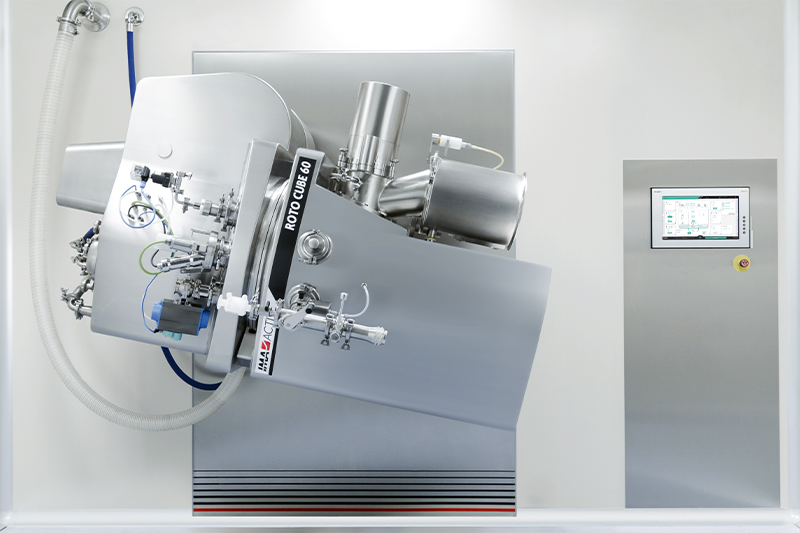
Compared to traditional granulation technologies, the ROTO CUBE Single Pot Processor combines all the different phases of wet granulation in a single machine. It mixes powdered ingredients, adds liquid binder to form wet granules, dries them, and sizes them with an integrated dry mill during unloading.
ROTO CUBE is often equipped with the Hydrowash washing unit, designed to be modular and to allow washing and final drying operations in fully automatic mode, managed by the ROTO CUBE control system. Thanks to its inherent design features, the ROTO CUBE's washing process is also carried out by combining maximum efficiency and very short operating times - resulting in minimal water consumption.
Sustainability advantages of ROTO CUBE technology
To put the benefits of Single Pot granulation technology into context, we should mention that several well-tested wet granulation solutions exist in the pharmaceutical industry. The most popular one is a line consisting of several unit operations: a high shear mixer granulator (HSMG), a wet mill, a dryer such as an oven or fluid bed dryer (FBD), upstream from a dry mill to ensure granule size uniformity.
In the first part of the process, ROTO CUBE operates instead like an HSMG, mixing the powders and granulating them with the addition of the binding liquid, thanks to the mechanical action of the impellers and the high shear stress; in the second part of the process, the wet granules are dried by ROTO CUBE itself. The ROTO CUBE granule drying technology consists in creating vacuum in the process container to dramatically decrease the vapour tension of the binding liquid and consequently, its boiling temperature. Meanwhile, the wet product is heated by conduction by the hot water circulating inside the jacket of the process bowl. The liquid evaporation rate can also be enhanced by GA.ST (gas stripping option): a low-volume air or nitrogen stream that once injected into the process bowl helps remove the granulating liquid vapours. To promote heat transfer and minimise product sticking to the bowl walls, the product mass is gently kept in motion by running the impeller intermittently at low speed and/or by tilting the bowl.
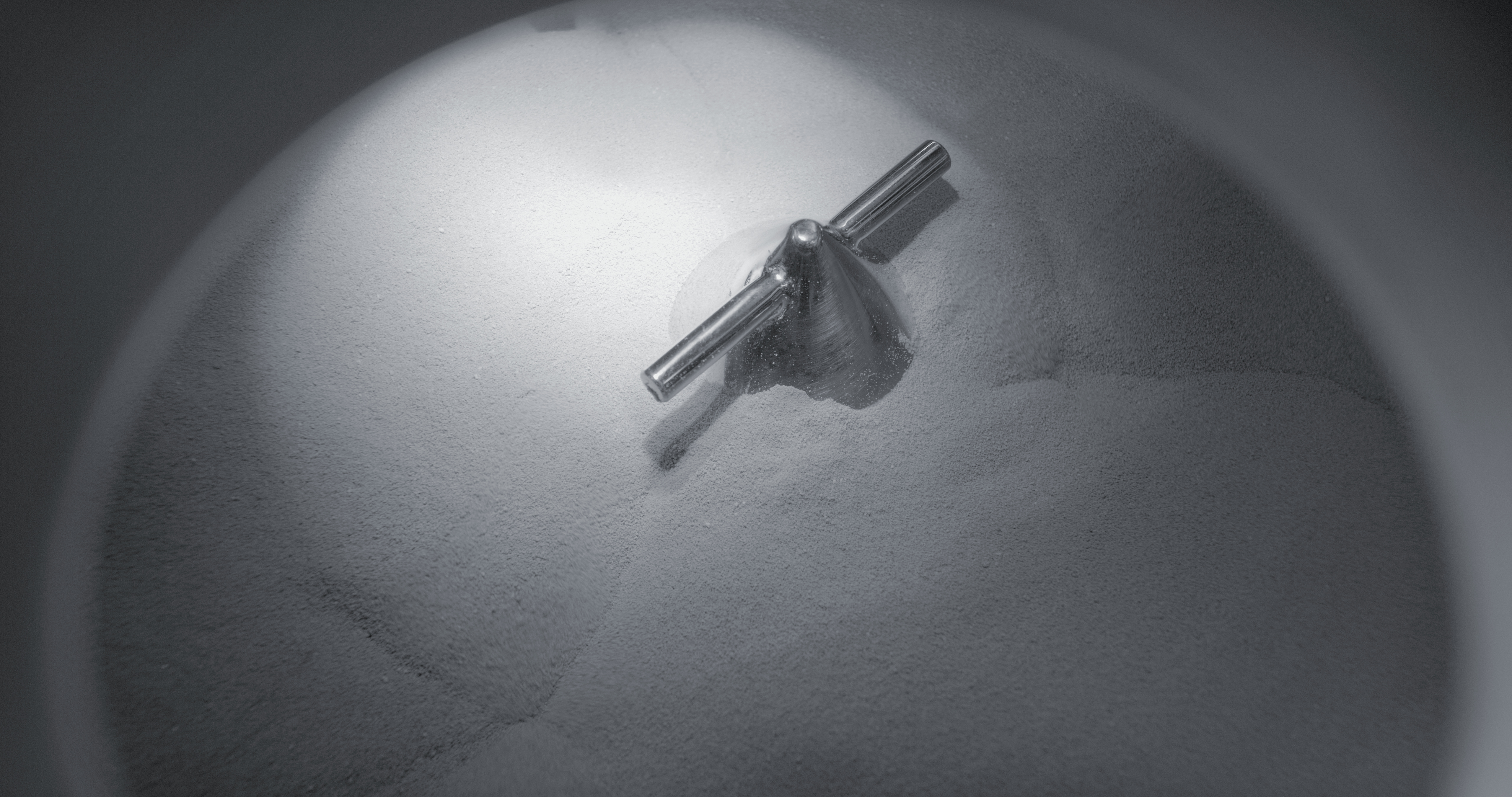
In practice, ROTO CUBE will let the dried granules out through a dry mill, ready for the subsequent steps required to produce sachets, capsules or tablets.
Advantages of ROTO CUBE Single-Pot technology over traditional granulation methods:
- Greater process containment: carrying out the process in a single vessel allows for better product containment, reducing the risk of product loss and providing greater protection for the operator.
- Lower emissions into the atmosphere: the process is carried out with less air displacement compared to technologies that heat the product by convection. In ROTO CUBE, comparing the same batch size, lower air flow rates are used. This not only helps process containment but also reduces emissions into the atmosphere.
- Reduced product transfer requirements: by using our ROTO CUBE, loading raw materials and unloading the finished granulated material is done in a single phase, without any intermediate transfers, so in addition to better product containment, this technology also avoids having to use additional piping where product residues might build up.
- Greater process efficiency: By eliminating the product transfers through wet mill and dryer, the product comes into contact with a significantly reduced total surface area, which improves product efficiency and optimises the procedure as well as consumption for cleaning operations.
- Greater process reproducibility. ROTO CUBE is a compact machine with integrated multiple functions, which makes it particularly suitable for automatic operation and less labour-intensive, achieving the target of higher reproducibility of granulation processes and of washing cycles.
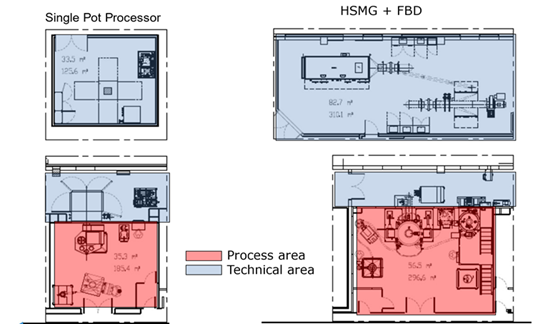
- Less space occupied: in the technical area the average space saving is 60% due to fewer utilities and the smaller size of the auxiliary units involved; in the process area the estimated space saving is on average 40% thanks to the double advantage of having a single machine with the extra plus of a very compact design as shown in figure X
- Lower environmental impact; ROTO CUBE technology is more sustainable throughout its life cycle, starting from the construction phase of the ROTO CUBE processor. Its compact design means fewer material and workmanship requirements - as well as fewer assembly operations. Sustainability advantages in terms of packaging, transportation, and civil engineering costs for ROTO CUBE installation should also be taken into account when calculating the environmental impact. Similar advantages are also obtained at the end of the machine's life when its disposal needs to be planned.
figure X:
Case study: washing and drying
Let's now review the ROTO CUBE washing and subsequent drying phases in greater detail; the washing process is necessary to restore the machine to clean conditions at the end of a production campaign, after a run of production batches, or to switch to a production campaign for a different product.
The cleaning process can include a number of options, typically chosen according to the type of product to be removed, the washing procedure applied and the configuration of the HYDROWASH washing skid. A washing cycle can be controlled under the following operating conditions:
- Selection of multiple lines to manage different washing fluids (tap water, softened water, purified water, etc.)
- Absence/presence of washing fluid heating
- Absence/presence of detergent. If detergent is used, management of different types of detergent.
Let's consider a washing cycle that is representative of a considerable number of actual cases, consisting of a sequence of several phases. This set of phases is the washing recipe - implemented by the ROTO CUBE control system. The recipe is structured so as to combine the functions of the HYDROWASH washing skid with the functions of ROTO CUBE, e.g. the use of the impeller, chopper and even of the drying functions, so as to also dry the entire surface in contact with the product at the end of the water washing phases.
Washing recipe diagram
- PHASE 1 - Washing by showering: in this first, short phase, water is used for washing dirt off the internal surfaces of the process bowl to preliminarily and roughly remove most residual product. A dedicated drain is often provided in this phase for the water with the highest concentration of residue to flow into, so that it can be treated specifically - ensuring separate disposal of the water from subsequent phases and rinsing.
- PHASE 2 - Filling wash: In this phase, a known quantity of water builds up inside the container, possibly mixed with a specific detergent. Once the filling level indicated in the recipe is reached, the process alternates between soaking, i.e., prolonged contact between the water and the bowl walls, and mechanical and chemical removal aided by the combined action of the impeller and chopper. This will both help mechanical detachment of any impurities and improve the effectiveness of the detergent. If necessary, the mix can also be heated using the heating jacket of the container to increase the efficiency of the washing treatment.
- PHASE 3 - Rinsing: In this phase, the washing residues dissolved in the previous phase are removed, along with any detergent residues. This phase can be performed in either the showering or the washing-by-filling mode and can be repeated to ensure that no traces are left behind in the case of highly water-insoluble residues.
- PHASE 4 - Final rinsing with purified water: This phase completes the rinsing operation using, however, purified water, to avoid the formation of limescale deposits or microbial formation. This phase is usually carried out in the filling mode so as to limit the consumption of purified water.
- PHASE 5 - Drying: once the washing phase is completed, the machine will move on to the drying phase to then be ready for a new work cycle. This phase includes both the draining and blowing of the washing fluid delivery lines and the actual drying of the process vessel. Bowl drying, as previously mentioned, is performed by using the drying functions provided by the ROTO CUBE design.
When it comes to complete washing cycles, the ROTO CUBE Single Pot technology offers significant advantages over a same-sized granulation line processing the same product using the same washing procedure.
In a nutshell: in addition to the obvious advantage of having to wash and dry a single machine instead of a line consisting of multiple unit operations, with ROTO CUBE the surface in contact with the product is easily cleanable - suffice it to say that the overall surface area of the filter material is smaller than that of a granulation line (particularly because of the filters present on-board a fluid bed machine) and therefore also easier to inspect after cleaning. Backfill washing, which is not an option in the fluid bed design, is also a possibility leading to a significant reduction in water consumption.
Conclusions
In a comparison between washing technologies, ROTO CUBE outperforms a traditional granulation line as far as all key indicators are concerned - starting from duration (approximately -20%) through water use (-64%) to energy consumption (-25%). As can be inferred, this is attributable to the total surface area in contact with the product being washed, which is in actual fact the smallest possible surface area. In particular, the machine's design contributes to a significant reduction in water consumption, as it is possible to create washing or rinsing phases for filling purposes that prolong the contact time between water and any dirt to be removed. Dirt dissolution is therefore facilitated - and so is dirt mechanical removal thanks to the mechanical action generated by the rotation of the impeller and chopper. In this situation, purified water savings of up to 70% can be achieved in the final rinsing phase.
Based on these considerations, being able to carry out the entire granulation process with a single processor like ROTO CUBE is highly efficient wherever very frequent washing cycles are required, due to continuous product changeovers as a result of extremely short production campaigns. For all these reasons, Single-Pot technology is recommended even when very thorough washing is required (e.g. for processes involving highly active products containing HAPIs) and in this case, the advantage of being able to carry out the process under high containment conditions is particularly appreciated.


