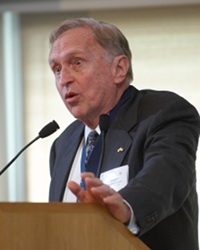
He will receive the medal during Innovation Day 2010 at the Chemical Heritage Foundation (CHF) in Philadelphia on 23 September in front of more than 200 scientific leaders from the chemical and molecular science industries.
‘Ron Breslow combines brilliance in research with great effectiveness in telling the story of the achievements of chemistry to all who will listen,’ said Sunil Kumar, president and ceo of International Specialty Products.
‘He is the central architect of two major areas of research: biomimetic systems and nonbenzenoid aromatic chemistry. His work offers promise of important breakthroughs in the fight against cancer by modulating gene transcription in cancer cells.’
For more than 50 years, Breslow has been a member of the faculty of Columbia University, which he joined after studying at Harvard. He has been active on many levels in the National Academy of Sciences (Chairman of the Chemistry Division 1974–77) and the American Chemical Society (ACS president, 1996; Priestley Medal, 1999).
The SCI Perkin Medal is recognised as the highest honour given for outstanding work in applied chemistry in the US. It commemorates the discovery of the first synthetic dye (the so-called Perkin mauve) by Sir William Henry Perkin in 1856. This discovery was a significant step forward in organic chemistry that led to the birth of a major segment of the chemical industry.
The Perkin Medal was first awarded to Sir William at a banquet held by the SCI in New York in 1906. Since then, more than 100 such awards have been given to notable scientists.
SCI awards Perkin Medal to Ronald Breslow
In recognition of his research into biomimetic systems and nonbenzenoid aromatic chemistry