
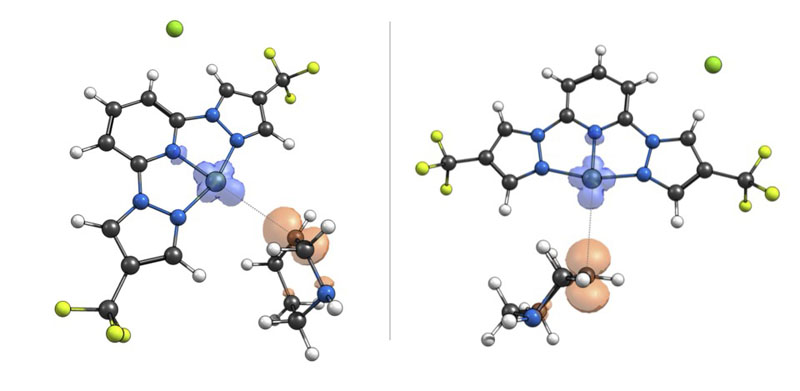
The radical rebound. Computational visualisation showing the carbon-centred radical (orange spin density) binding to the nickel-centred radical (blue spin density). Two perspectives are shown.
Chemists at Scripps Research have developed a nickel-catalysed cross-coupling reaction that joins two carbon fragments while preserving their 3D molecular geometry — a longstanding challenge in pharmaceutical synthesis.
Published in Science, the method achieves 80–96% enantiospecificity and yields of 40–90% across a broad range of pharmaceutically relevant substrates, including piperidine and pyrrolidine scaffolds.
Critically, it requires no chiral ligands or specialised additives and runs under standard lab conditions.
The reaction couples a sulfonyl hydrazide with an alkyl halide via short-lived carbon radicals. A "caged radical rebound" mechanism on the nickel centre preserves chirality before scrambling can occur — without the need for additional redox reagents.
The practical gains are significant. One medicinally relevant piperidine building block previously requiring seven synthetic steps was produced in a single coupling step at a yield of 60% with 95% stereoretention.
The process scales to gram quantities and tolerates the functional groups — free amines, olefins, heterocycles, aryl bromides — that medicinal chemists depend on.
"If we can simplify how those structures are assembled, it changes how chemists approach synthesis from the ground up," said senior author Phil Baran, professor at Scripps Research.
The method is expected to shorten synthetic routes and reduce waste in drug discovery workflows, particularly when combined with AI-assisted route planning.


