
UK and US Stem Cell Banks team up to share expertise
Plan to drive forward stem cell research
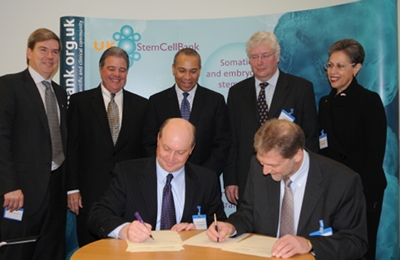
The UK and UMASS Stem Cell Banks have signed a Memorandum of Understanding (MOU) that will outline plans for cooperation in a variety of stem cell areas including the delivery of stem cell lines for clinical use.
The agreement outlines plans for the two stem cell banks to work together to ensure that best practice and high standards in stem cell banking are employed at both sites. They will also develop international training events for scientists involved in stem cell research.
Stem cells are the body's 'master cells', with the potential to become many different types of tissue. It is hoped that stem cell treatments may be used in future to help people with Parkinson's disease, diabetes or multiple sclerosis by repairing and replacing diseased and damaged body tissue.
The UK Stem Cell Bank, funded by the Medical Research Council and the Biotechnology and Biological Sciences Research Council, is a repository for human cell lines, derived from stem cells. It also holds new and existing adult, foetal and embryonic stem cell lines. Stem cell lines are provided only to accredited researchers to ensure the safe and ethical development of any potential stem cell therapy.
Dr Stephen Inglis, director of HPA's NIBSC said: ‘International co-operation is vital in this fast moving field and we expect that the partnership will accelerate the development of important new therapies, as well as keeping the UK at the forefront of stem cell research.’
Joseph Laning, senior director of the Human Stem Cell Bank and Registry at UMASS Medical School, added: ‘Both banks share common goals and needs. Working in concert allows us to develop strategies that will shape stem cell production, characterisation, banking and distribution in a dynamic field. Each bank brings its own unique attributes to bear in a way that will enhance our influence in the field.’
You may also like

Trending Articles
-
You need to be a subscriber to read this article.
Click here to find out more.


