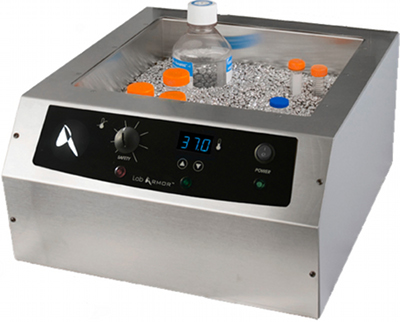
Waterless alternative to laboratory baths
Bead Bath delivers temperature uniformity while eliminating water
The San Antonio, Texas-based firm says the waterless Bead Bath delivers exceptional temperature uniformity while eliminating water, which can be a major source of contamination in laboratories.
The Bead Bath is always on, ready for the next experiment, so scientists do not have to plan around warm-up times. There is also no risk of burn out because there is no water to evaporate. The Bead Bath also keeps samples organised, naturally holding vessels in place without the need for racks, floats and bottleneck weights.
In addition to watertight containers, scientists can safely incubate multi-well plates, petri dishes, and open-top samples at any angle.
The Bead Bath also requires little maintenance.
Lab Armor Beads can be used to replace water in existing water baths, aluminum blocks in dry baths and even ice in ice buckets. These beads can also be used in containers placed in ovens and incubators to replace sample racks.
The Lab Armor Bead Bath’s thermal uniformity is: 37°C ±0.5°C and 65°C ±1.0°C with a temperature range of 5°C above ambient to 80°C. They support a temperature range of –100°C to +400°C in laboratory equipment.

You may also like
Trending Articles
You may also like
Manufacturing
SCHOTT Pharma launches EVERIC lyo & amber vials for light-sensitive ADCs
Featuring the well-known EVERIC® lyo coating, EVERIC® lyo & amber is designed for lyophilised, light-sensitive antibody-drug-conjugates (ADCs). It offers reliable light protection at the primary packaging level, already during the fill-and-finish process. EVERIC amber is the first specialty vial for highly light-sensitive medications that simultaneously meets regulatory light transmission requirements in the EU, the U.S., and Japan
You need to be a subscriber to read this article.
Click here to find out more.
Manufacturing
Portable gas detection in the pharmaceutical sector
Gas safety is a critical consideration in the pharmaceutical sector. Hazardous gases and airborne contaminants are common by-products of manufacturing processes … and employers must control worker exposure in accordance with relevant legislation and industry standards
Manufacturing
New legal duties for QPs in decentralised manufacturing
In this clip, Dr. Peter Gough explains that QPs will be responsible for supervising decentralised activities, conducting regular audits, carrying out periodic on-site visits, confirming GMP compliance to regulatory authorities and notifying changes that may affect quality or safety
Manufacturing
FDA escalates action against Dabur India over systemic data-integrity and cGMP failures
The US FDA has issued a warning letter to Dabur India following an inspection that identified falsified records, missing laboratory data, inadequate cleaning and process validation and weaknesses in quality-unit oversight, saying the company's response failed to address the systemic nature of the deficiencies
Manufacturing
DNA Script and GE Healthcare awarded $26m ARPA-H funding to scale cell-free DNA bioproduction
The pair will combine DNA Script's EDS technology with GE HealthCare's DNA scaling technology to create a faster, more flexible manufacturing process for cell-free DNA as the use of personalised and time-sensitive genetic medicines grows