
Astell units sterilise contaminated lab waste
Astell markets liquid waste treatment plants for Category 3 and 4 labs
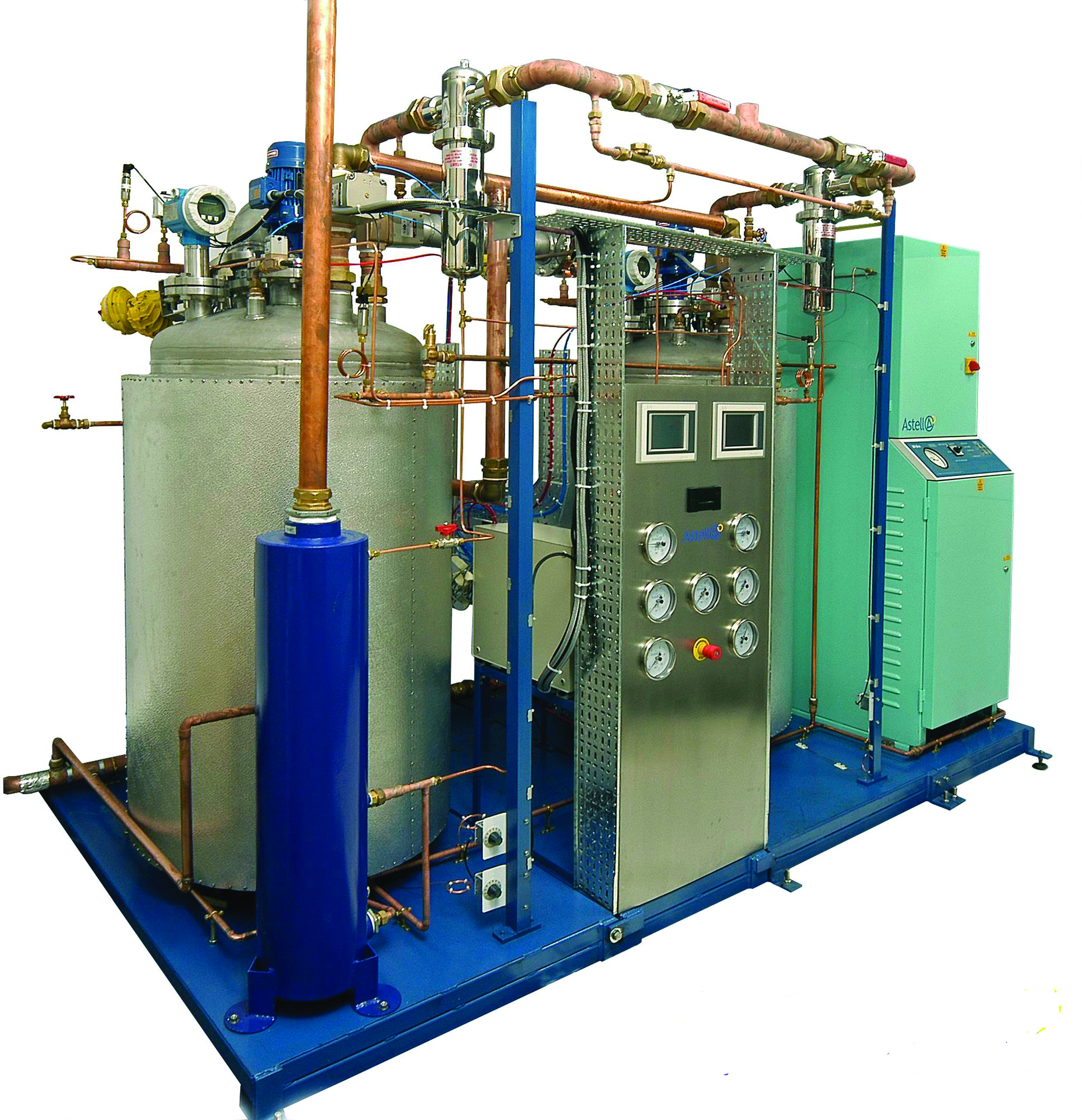
Current legislation requires that all waste water from sinks, washrooms, sanitary installations and similar facilities within these designated areas have to be sterilised prior to discharge to sewer. The Astell units cover capacities from 100 to 5000 litres of liquid waste per day.
In the standard batch processing unit, liquid waste is collected in a stainless steel jacketed containment tank. When the radar level controller detects that the tank is full, the heat sterilisation sequence starts automatically.
Heating is by steam supplied either from the unit’s integral steam generator or from an external source. Once the sequence is complete, the sterilised effluent is discharged to sewer using compressed air.
Continuous processing units are provided with two tanks. The first tank is filled as in the batch operation, and commences sterilisation. Influent liquid waste is then diverted to the second tank. When the sterilisation sequence is complete, the tank remains idle until the second tank is full. In this way effluent collection is continuous so there is no delay to laboratory operations.
Each tank is fully contained and all connections are above liquid level eliminating dangerous and costly leaks. A vent filter ensures that no microbial contaminants can be discharged with air or vapour. Access to the fully programmable controller is via Astell’s PIN protected, full colour touch screen which displays cycle information and has facilities for data archiving and ethernet monitoring.
Astell offers full project assistance including an initial site survey to ascertain the volume of waste and advise the best treatment method, detailed engineering proposals, manufacture, delivery and installation of the equipment and IQ and OQ validation packages.


