
Dolomite, a manufacturer of microfluidic systems and devices, has developed a novel droplet merger chip with GigaGen of San Francisco, CA for massively parallel single cell genetic analysis.
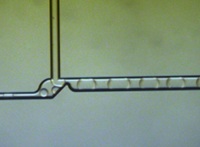
Measuring 15mm x 22.5mm, the glass microfluidic chip facilitates fast and consistent merging of two individual droplet streams, benefiting a range of applications including DNA amplification, biochemical analysis, single cell analysis and high throughput experimentation. Unlike other methods, which incorporate expensive and bulky high voltage electronics to merge droplets using electrostatic forces, the droplet merger chip works by simply “squeezing” droplets together in a carefully designed merging chamber.
Dolomite says the result is a unique microfluidic device, which points the way to low cost disposable chips in future versions.
‘A simple and reliable droplet merging technology is an important step forward for us,’ said David Johnson, chief executive and founder of GigaGen. ‘We are now using these chips in our system for massively parallel single cell genetic analysis.’
GigaGen has filed a patent application describing the chip design and its applications in the field of genetic analysis of cells.
As part of a licensing agreement with GigaGen, Dolomite will be offering the technology later this year to researchers in academia and commercial users in a wide range of application areas.
‘Many of our customers have asked us for chips to create droplets, merge them, and then carry out further processing and analysis,’ said Andrew Lovatt, chief executive of Dolomite.
‘Our partnership with Sphere Fluidics gives us additional capability in selecting the surfactants we use, to optimise droplet behaviour and stability under a wide range of temperature and biological conditions.’
Dolomite and GigaGen develop droplet merging technology
For use in massively parallel single cell genetic analysis
You may also like

Trending Articles
-
You need to be a subscriber to read this article.
Click here to find out more.
You may also like

Manufacturing
Dolomite and Lab on a Chip launch Productizing Science Competition 2015
Dolomite and Lab on a Chip are challenging entrepreneurial researchers, scientists and engineers to enter the Productizing Science Competition 2015, proposing novel, microfluidics-based concepts with commercial potential


