
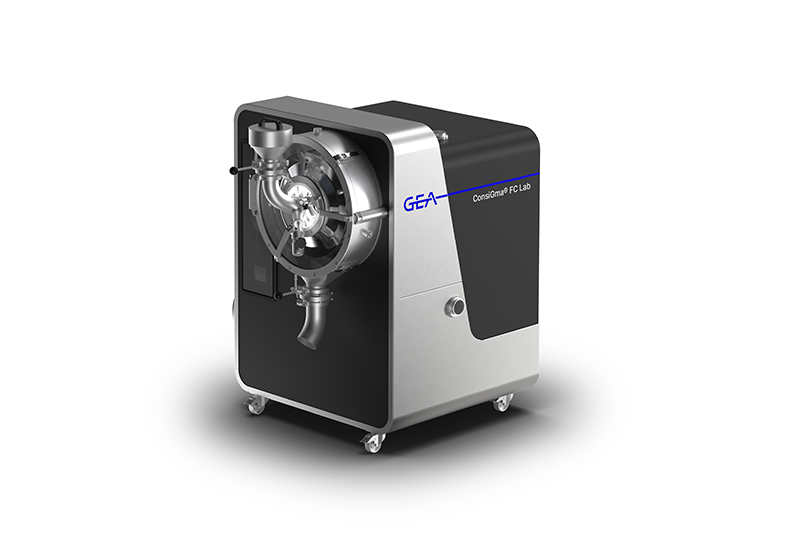
In pharmaceutical development, time is everything. Every additional week spent on process optimisation in the laboratory is a week of potential revenue lost. What’s more, every failed scale-up attempt risks derailing the carefully sequenced steps between formulation development and commercial launch. For those working at the R&D stage, tablet coating has long been one of the discipline’s most persistent bottlenecks: a process defined by slow batch cycles, high material consumption and a disconnect between laboratory results and production-scale outcomes. GEA’s ConsiGma ® FC Lab Coater (CFC Lab) is designed to change all that.
The challenge with conventional lab-scale coating
Traditional tablet coating drums operate at very low rotational speeds (as little as 5 RPM), creating a rolling bed of cores to which a coating solution is applied. The approach is well-established, but it comes with significant drawbacks when deployed at laboratory scale. Batch cycles are lengthy, material waste is high and the process is inherently unsuited to the rapid and iterative experimentation that effective Design of Experiment (DoE) demands. Operators frequently find that parameters optimised in the lab do not transfer to production equipment, thereby triggering costly and time-consuming revalidation work.
Never a formulator’s ideal outcome, soft or friable tablet cores present further challenges. Prolonged tumbling in a conventional drum can cause attrition, resulting in yield losses and uneven coating. Whereas conventional approaches may require the core to be strengthened or reformulated before coating can be attempted, the CFC Lab’s gentle processing environment accommodates even the most mechanically sensitive tablets, thereby removing this additional burden from the development cycle. And, for formulators working with highly potent active pharmaceutical ingredients (APIs), the containment requirements of conventional open-bowl systems add yet another layer of complexity and cost.
A fundamentally different approach to coating
Based on GEA’s ConsiGma ® coating technology, the CFC Lab takes a radically different approach to the process. Rather than tumbling tablets in a slow-rotating drum, the system pairs high drum rotation speeds with an air-knife mechanism that separates and spins each tablet as it passes through the spray zone. Tablets are coated in a free-fall cascade, receiving a microcoat 90 times per minute (1.5 micro-applications per second) with each coat drying instantly before the next is applied. The result is a highly uniform 360° coating that’s achieved in a single pass.
This continuous in-flight approach delivers coating homogeneity at a weight gain of just 2% compared with the 3% typically associated with conventional processes; that’s a 33% reduction in coating material consumption. Critically, it compresses the entire batch cycle to as little as 6 minutes, meaning that a complete DoE can be executed in a single working day. What would ordinarily require weeks of laboratory time can now be accomplished before lunch.
The free-fall mechanism also makes the CFC Lab particularly well-suited to challenging tablet cores. Because the tablets reconnect with the drum gradually rather than through sustained mechanical contact, the process is exceptionally gentle, which is an important advantage for soft, friable or unusually shaped cores that a conventional rolling bed might damage.
Eliminating the scale-up problem by design
Perhaps the most significant advantage of the CFC Lab for pharmaceutical formulators is what GEA describes as “scale-out rather than scale-up.” In conventional development workflows, the equipment used during R&D is geometrically different from the production-scale system. As such, a separate optimisation phase is required during tech transfer. Parameters rarely translate directly and the regulatory burden of revalidation at each transition can add months to the timeline.
The CFC Lab eliminates this problem. All ConsiGma ® Film Coaters share the same drum diameter; to accommodate larger production batches, the coating wheel depth can be increased and additional spray nozzles added, but the fundamental process geometry remains identical. The CFC Lab features an 80 mm wheel and can handle batch sizes of 0.5–1.5 kg. Production sub-batches scale linearly to 9 kg using the same drum diameter — without adding to the sub-batch/process time of 6 minutes. This
means that process parameters developed in the laboratory apply directly to commercial manufacturing trains with zero scale-up rework and a substantially reduced regulatory burden. It should also be noted that it’s easy to use the system in tandem to achieve higher throughputs.

Mark Rowland, Director of Product Management, Pharma Solid Dosage, at GEA, notes that conventional coaters “can cause attrition with softer tablets, leading to yield losses and an uneven coating.” He adds that the new approach “can coat products that were never thought possible, such as unusually shaped cores.”
Designed for every coating challenge
Apart from rarely used sugar coatings, the CFC Lab is engineered to handle the full breadth of applications encountered in pharmaceutical R&D. For aesthetic coatings, the system delivers vibrant, uniform colour application with precise batch-to-batch consistency, which is important both for product differentiation and patient compliance. Protective coatings, including barrier and moisture-protection formulations, can be applied to shield APIs from oxygen, humidity and light, extending both product
stability and shelf-life. For functional coatings, the platform supports enteric, sustained- and delayed-release formulations, enabling precise pharmacokinetic profiles to be developed and optimised on the same system that will be used at commercial scale.
Containment is another area in which the CFC Lab distinguishes itself from conventional alternatives. The system is OEB4-ready as standard, with containment engineered into the design rather than being retrofitted as an afterthought. BUCK ® MC Split Valves enable high-potency tablets to be loaded and discharged without risk of operator exposure, eliminating the need for specialist PPE and minimising housekeeping requirements by preventing dust emission. Optional wetting/washing capabilities provide an additional layer of contamination control for the most demanding high-potency applications.
Part of a comprehensive R&D ecosystem
The CFC Lab does not operate in isolation. It integrates seamlessly with GEA’s AirConnect platform (a modular system that supports fluid bed drying, granulation and tablet coating processes at pilot-scale capacities of 100 g to 10 kg). The platform includes modules for fluid bed drying, top-spray granulation, side-spray granulation (FlexStream) and pellet coating, and bottom-spray precision coating, with the CFC Lab completing the full oral solid dosage (OSD) R&D workflow from granule to coated tablet using a single control unit.
The practical implications of this integration are significant. By consolidating automation and air-handling functions across all processes onto a single platform, capital investment and operational expenditure are both reduced. Operator training is simplified because familiarity with one module transfers directly to the others. Qualification, calibration and maintenance activities are streamlined because there is only one system to manage. Valuable laboratory space is used more efficiently and the administrative overhead of maintaining multiple equipment qualification dossiers is substantially reduced.
A clearer path from laboratory to market
For pharmaceutical formulators, the commercial case for the CFC Lab is straightforward:
- faster optimisation reduces development timelines
- identical geometry from lab to production eliminates revalidation costs
- reduced coating material consumption cuts waste by more than 90% (compared with conventional processes)
- built-in containment removes the need for expensive engineering controls or protective equipment.
Every week saved during formulation development is a week of revenue gained. For an industry in which the cost of delay is measured in both financial terms and time-to-market, that proposition is compelling. GEA’s CFC Lab Coater represents a step change regarding what’s possible at laboratory scale — and a persuasive argument to reconsider the assumptions that have defined tablet coating development for decades.
Click here to download the Consigma FC Lab leaflet.