
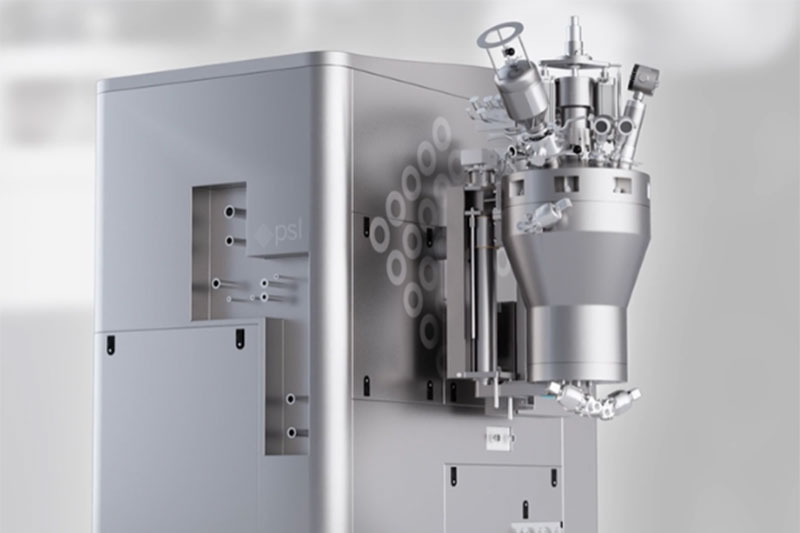
Interchangeable mesh technology lets CDMOs run diverse microsphere formulations on a single refiner platform, cutting spend, changeover time, and scale‑up risk. This represents enormous potential gains. While the global market for drug delivery systems using polymeric microspheres is forecast to exceed $10 billion by 2033, the broader CDMO market is projected to reach $580 billion by 2034*. These aren’t numbers that reward inflexibility.
Yet for many contract development and manufacturing organisations, developing drug-loaded microspheres and other microsphere products still means dedicated equipment for each drug formulation. A new client brief for a novel polymeric microsphere delivery system triggers a capital discussion. Scale-up to commercial production means another procurement cycle. And when timelines compress, as they always do, the bottleneck isn’t science, but infrastructure.
Process consolidation: One platform, many products
Different drug formulations demand different parameters. This is a core challenge of microsphere processing.
- Size specifications vary widely, from sub-micron to several hundred microns depending on the intended drug delivery system.
- The choice of organic solvent in spray drying or solvent evaporation approaches affects both drug loading efficiency and final product yield.
- Phase separation processes require precise control.
- Drying methods must account for the thermal sensitivity of both the active compound and the biodegradable polymer matrix.
Traditionally, meeting these varied requirements has meant varied equipment, each dedicated to a single microsphere product or family. An interchangeable mesh changes that logic entirely.
By allowing operators to swap mesh assemblies within a single processing unit, the same microsphere refiner can be reconfigured to achieve different classification cut-off points across a wide particle size range, without a new vessel, without a new line, and without a new validation burden from scratch. This is particularly valuable in the filtration and drying stages, where spherical particle quality control is most sensitive to equipment consistency.
Filtration and classification
Mesh interchangeability means a single unit can be reconfigured for different cut-off points, accommodating the specific microsphere size distributions required by different drug formulations without additional expenditure on dedicated sieves or classifiers. Whether you’re processing sub-5 micron particles or larger reservoir-type microspheres, a single refiner handles both.
Washing and solvent exchange
Programmable wash cycles allow straightforward switching between organic solvents and buffers, critical for removing residual solvent from spray drying or solvent evaporation processes and maximising product yield. Parameters are set in software, not hard-wired into equipment, meaning the platform adapts to the chemistry, rather than constraining it.
Software and quality control
Programmable process sequences mean parameters are defined, stored, and recalled digitally. Recipe-based operation reduces reliance on manual adjustment and creates a consistent, documented process from the first batch (key for meeting quality control requirements and regulatory compliance).
Rapid changeover and cleaning: Downtime as a design problem
For CDMOs scaling microsphere drugs from development to commercial production, changeover time is a commercial variable that directly impacts profitability. Every hour between campaigns is an hour not billable, not productive, and not competitive. Equipment that requires extensive teardown between different drug formulations or microsphere products imposes a real cost, in time, in labour, and in the drag it puts on scheduling.
A microsphere refiner designed around modular vessel architecture approaches this differently. Individual components can be removed, inspected, and reassembled quickly, while integrated clean-in-place (CIP) and steam-in-place (SIP) capabilities go further. Rather than manual strip-and-clean protocols between campaigns producing different microsphere products, automated cleaning cycles run within the vessel itself (validated, repeatable, and traceable). The time between the last batch of one drug-loaded microsphere formulation and the first batch of the next shrinks considerably, reducing capital tied up in idle systems.
Containment is critical for CDMOs handling drug formulations with potent active ingredients. A platform designed with appropriate containment standards from the outset removes the need to retrofit safety measures around equipment not originally specified for potent compounds, allowing a single refiner to serve both standard and high-potency microsphere campaigns.
Scalability: From pilot to commercial production without starting over
Perhaps the most significant commercial advantage of a configurable microsphere refiner is what it means for scale-up continuity in drug formulation development.
When process parameters are established at pilot scale on the same platform architecture as commercial production equipment, the translation from development to manufacturing doesn’t take a redesign: the mesh is interchangeable, the operating logic is the same. The uncertainty that typically accompanies scale-up, and the risk to product yield , narrows considerably.
This has direct implications for client acquisition. A new brief no longer necessarily requires a commitment to a dedicated line. If a microsphere refiner can be reconfigured for the specific requirements of a new drug delivery system, the business case for taking on a new microsphere product becomes much more straightforward.
Pre-designed process sequences and recipe-based operations also accelerate tech transfer. When a new client brings their drug-loaded microsphere formulation to your facility, the pathway from their data to your running process is shorter, better documented, and easier to validate.
The CDMO case for configurable microsphere processing
A microsphere refiner built around configurability enables CDMOs to achieve more without proportional increases in either capital or complexity. Filtration and drying in a single, reconfigurable unit reduces the infrastructure overhead associated with formulation diversity. Modular design and integrated cleaning capability reduce the time cost of changeover. And scale-up continuity means development work compounds, rather than resets, as microsphere drugs advance from pilot through commercial production.
Browse the PSL Microsphere Formulation page for more information on scalable production and innovative microsphere technology.