
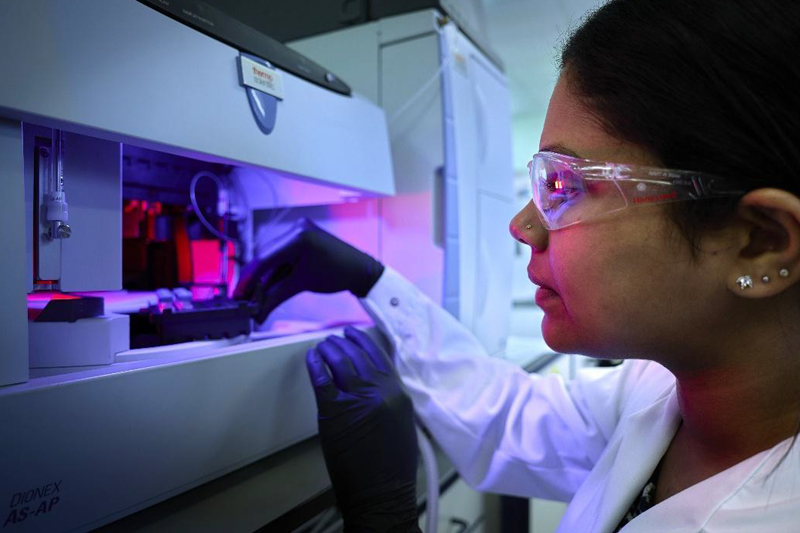
Since its introduction in the 1970s, ion chromatography (IC) has evolved from a niche environmental technique into a core tool in pharmaceutical analysis. Developed by Hamish Small at Dow Chemical and commercialised by Dionex Corporation, IC provides sensitive and selective determination of ionic species. However, its adoption in the pharmaceutical sector has been gradual. I first came across the technique whilst working at Kodak Research around 1980.
Early Challenges and Diverging Technologies
Early IC systems relied on suppressed conductivity detection, in which chemical or electrolytic suppression reduces the eluent background to enhance analyte response. While highly sensitive, these systems required careful maintenance and were not particularly robust in early iterations.
The development of non-suppressed systems, particularly by Metrohm, introduced simpler operation using low-conductivity eluents and direct detection. Although more user-friendly, the coexistence of suppressed and non-suppressed platforms posed challenges for method transfer due to differences in selectivity, eluent chemistry, and detector response.
Combined with limited pharmacopoeial guidance and reliance on established wet chemistry methods, these factors slowed adoption.
Regulatory Drivers and Technical Maturity
Advances in column chemistry, suppressor technology, and detector performance through the 1980s and 1990s improved IC reliability. Broader uptake followed in the 2000s, driven by stricter impurity and validation requirements under International Council for Harmonisation of Technical Requirements for Pharmaceuticals for Human Use guidelines (Q3A, Q3B, Q3D).
Pharmacopoeial recognition was pivotal. The United States Pharmacopoeia incorporated IC into General Chapters <621> and <1225>, while the European Pharmacopoeia introduced Chapter 2.2.28. These frameworks are deliberately technology-neutral, defining system suitability criteria, such as resolution and sensitivity, rather than prescribing instrumentation.
This performance-based approach supports both suppressed and non-suppressed systems. Still, it places greater emphasis on method validation and on controlling parameters such as eluent composition, column selectivity, and detector response.
Established Applications
IC is now widely applied across pharmaceutical QC and development, including:
- Inorganic impurity profiling (ICH Q3D)
- Counterion determination in drug substances
- Cleaning validation (trace ionic residues)
- Water and excipient testing
- Carbohydrate, aminoglycoside and antibiotic analysis (e.g., PAD detection)
Butterworth Laboratories routinely uses IC for method development, validation, and routine testing. The laboratory collaborates closely with clients to develop, optimise, and validate new IC methods tailored to specific products, impurities, and regulatory requirements, supporting both compendial compliance and bespoke analytical challenges. Butterworth first introduced IC in the mid-1980s to determine halides following oxygen combustion in elemental microanalysis, and it has since expanded its use significantly as the technology has advanced—and will continue to do so.
Outlook
While IC is now well established, challenges remain, particularly in method transfer between differing system architectures and in reproducing compendial methods without explicit system details. Nevertheless, ongoing advances in automation, suppressor design, and detection continue to enhance robustness and usability.
Conclusion
Ion chromatography is now a mature, versatile technique aligned with modern regulatory expectations. Its broader adoption reflects the industry's shift toward more selective and sensitive analytical methods, supported by specialist laboratories such as Butterworth Laboratories, which provide the expertise and experience required for effective application.
Currently, it is expanding into new fields. It helps tackle modern challenges, such as using combustion IC (C-IC) to determine PFAS, developing UV-IC to quantify transition metals, and applying UV-Conductivity-IC for nitrite analysis as part of the nitrosamine problem—an area we are actively working on.