
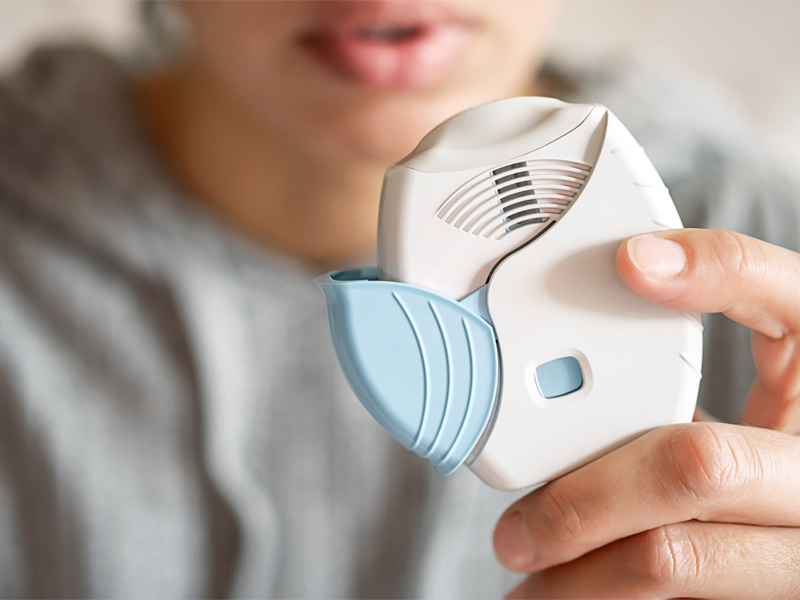
Inhalable dry powders occupy one of the most technically demanding spaces in pharmaceutical manufacturing. Unlike oral solid-dose products, inhaled therapeutics rely on engineered particle interactions, ultra-low dosing and aerodynamic performance to ensure direct delivery to the lungs.
The margin for error is exceptionally small. Success depends less on the formulation itself and more on the precision and control embedded within the production process.
From micronisation and blending to containment and scale-up, manufacturers must overcome a series of interconnected hurdles. Each processing decision influences not just product quality, but also operator safety, regulatory compliance and commercial scalability.
The micronisation challenge: engineering particles for performance
Deep lung deposition requires particles that range from 1–5 µm in size. Achieving and maintaining this specification can be challenging. Jet milling and other micronisation techniques can reliably reduce particle size, but they also increase surface energy, cohesivity and electrostatic charge.
Micronised active pharmaceutical ingredients (APIs) are highly respirable and, at the same time, inherently unstable. Their small mass and large surface area make them prone to agglomeration, inconsistent flow and unintentional dispersion. Even slight variations in milling energy, feed rate or environmental humidity can impact the particle size distribution (PSD), affecting fine particle fraction (FPF) and emitted dose performance.
The hurdle is not simply achieving the target PSD once — it is maintaining reproducibility batch after batch. Robust in-process controls, environmental monitoring and stringent parameter control are essential. Without them, downstream blending uniformity and aerosol performance can drift beyond acceptable limits.
Cohesion versus homogeneity: the blending dilemma

Perhaps the most critical production hurdle for inhaled powder manufacturing lies in blending. In many formulations, the API concentration may be less than 1%, meaning that a 10 mg dose might only contain 100 µg of active material.
Every capsule or blister must deliver that precise amount. Yet both components in a typical blend — the micronised API (1–5 µm) and the lactose carrier (commonly ~50 µm) — naturally prefer self-association. Fine API particles form cohesive agglomerates. Carrier particles may also cluster. The objective of blending is to break these cohesive bonds and promote the uniform distribution of API across the carrier surface without over-processing.
Low-shear tumble blending often struggles to overcome cohesive forces, resulting in higher relative standard deviation (RSD) values and inconsistent content uniformity. Conversely, excessive shear can alter particle morphology or generate additional fines, potentially impacting aerosolisation. High-intensity blending systems have emerged as a solution to this dilemma.
By applying sufficient mechanical energy, the cohesive bonds between API particles are disrupted, enabling intimate mixing with the carrier. Systems capable of achieving RSD values near 1% represent a significant advancement compared with traditional blending approaches, which may yield 4–8% RSD under similar conditions.
The challenge is calibrating energy input precisely: enough to ensure homogeneity, but not so much that it degrades the formulation. Process development must therefore focus on impeller speed, blending time and fill volume to identify a narrow optimal operating window.
Stability under stress: maintaining uniformity through transfer and filling
Achieving uniformity in the blender is only part of the battle. DPI powders are sensitive to segregation during transfer, storage and device filling. Differences in particle size and density between API and carrier can cause “demixing” under vibration or during filling operations.
Production-scale equipment must therefore minimise drop heights, reduce excessive vibration and limit open transfers. Closed, gravity assisted discharge systems and contained transfer interfaces can help to preserve blend integrity. Without careful engineering, the content uniformity achieved during blending may degrade before the product even reaches the filling line.
Containment: managing the invisible risk
Many inhalation APIs fall within Occupational Exposure Band (OEB) 4 or 5. These compounds are potent at microgram-level doses and may carry occupational exposure limits (OELs) in the low microgram per cubic metre — or even sub-microgram — range.
At the same time, micronised particles are easily airborne and often invisible when dispersed. Their aerodynamic properties, ideal for lung deposition, also make them capable of lingering in facility air if released.
Containment is therefore not optional when manufacturing these products; it is foundational.
Engineering controls must address both potency and dispersibility. Key risk points include:
- API charging into blenders
- in-process sampling
- discharge of finished blends
- sieving and classification steps
- equipment cleaning and changeover.
Closed handling systems, split butterfly valves, isolators and contained transfer technologies reduce the open manipulation of powders. Proper HVAC zoning and pressure cascades further limit cross-contamination risk. Importantly, containment supports more than operator safety.
Airborne particles settling on surrounding equipment increase cleaning validation complexity and cross-product contamination risk in multiproduct facilities. Effective containment enhances product quality and operational efficiency while simplifying regulatory compliance.
Scaling without compromise
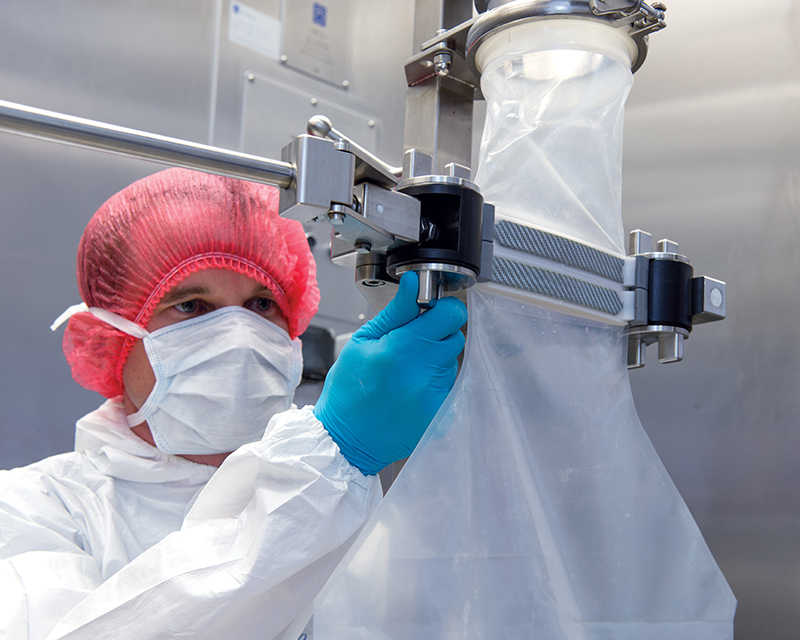
Scaling inhalable powder production from development to commercial volumes presents another hurdle. A process that performs well at the 1–5 kg scale may behave differently at 30–50 kg. Changes in bowl geometry, fill depth or impeller tip speed can alter energy distribution and mixing dynamics. Successful scale-up requires maintaining geometric and dynamic similarity whenever possible.
Equipment platforms offering multiple bowl sizes within a consistent design architecture can simplify this transition.
Still, scale-up demands careful validation of blend uniformity, segregation resistance and aerosol performance at each stage. Without a rigorous scale-up strategy, manufacturers risk multiple optimisation cycles that delay commercialisation and increase cost.
Integrating safety, quality and performance
What distinguishes dry powder manufacturing from many other dosage forms is the degree to which safety, quality and performance are intertwined. A change introduced to improve content uniformity may affect aerosolisation.
A containment upgrade may alter transfer dynamics. Environmental adjustments may shift blend behaviour. The production process must therefore be engineered holistically. Equipment design, containment strategy, blending intensity, environmental control and material handling cannot be treated as isolated decisions.
Modern high-shear blending technologies integrated within closed processing platforms represent one way to address multiple hurdles simultaneously — improving homogeneity, stabilising API-carrier interactions and supporting contained operation.
Offering operator benefits
Technologies from GEA Group are designed not only to engineer optimal particle performance but to simplify day-to-day operations in R&D, clinical and commercial production environments.
Spray drying further enhances operator efficiency by consolidating particle engineering into a single, continuous process step. Rather than relying on multiple downstream operations such as milling and classification, spray drying converts a liquid feed directly into an inhalable dry powder with a tightly controlled particle size, morphology and density.
Systems such as the NIRO PHARMA-SD enable operators to fine-tune atomisation parameters, inlet temperatures and drying gas flow through integrated control systems, helping to maintain consistent product quality with reduced manual intervention. Automated monitoring and recipe control reduce variability and simplify technology transfer from development to commercial scale.
At the blending stage, high-speed systems such as GEA’s TRV (turbo rapid variable) mixer provide significant operator advantages. DPI formulations are often highly potent, low-dose and sensitive to segregation. The TRV’s controlled, high-intensity mixing action supports rapid homogenisation reducing blend times and improving quality control (content uniformity).
Compact, contained designs also support safe handling of potent APIs, while streamlined discharge and cleaning procedures reduce downtime between batches. In R&D environments, where frequent formulation iterations are common, this operational flexibility is particularly valuable.
Containment and cleanability are also central to operator benefit. DPI manufacturing frequently involves high-potency compounds that require strict exposure controls.
GEA technologies can be configured for high containment and closed powder handling, protecting personnel while maintaining compliance with cGMP standards.
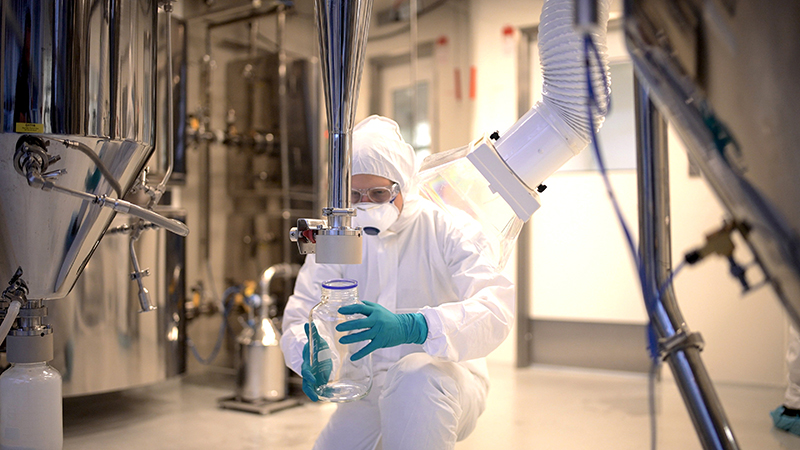
Clean-in-place (CIP) capabilities and hygienic design features shorten turnaround times and reduce the risk of cross-contamination, which are key considerations in multiproduct facilities.
Importantly, the scalability of GEA’s platforms reduces operational risk when transitioning from laboratory development to full commercial production. Comparable process configurations across scales mean that operators do not have to relearn fundamentally different systems as output increases.
This continuity improves training efficiency, minimises validation burden and accelerates time-to-market. For manufacturers of DPI products, the result is not only optimised powder performance, but a production environment that is safer, more predictable and more efficient for the people running it.
Conclusion: engineering precision into every step
Inhalable dry powder manufacturing is an exercise in precision engineering. The therapeutic dose may be measured in micrograms, but the complexity of delivering it consistently spans micronisation physics, powder mechanics, occupational safety and regulatory compliance.
Overcoming production hurdles requires more than robust formulation science. It demands controlled energy input during blending, vigilant containment strategies, environmental discipline and thoughtful scale-up planning. As respiratory therapies continue to expand globally — and as molecules become more potent — the operational expectations placed on DPI manufacturers will only intensify.
Those who succeed will be those who view production not as a sequence of steps, but as an integrated system designed to balance homogeneity, stability, safety and scalability in every batch. Precision is not a feature of inhalable dry powders. It’s a prerequisite.
Ready to optimise your inhalable powder process? Discover how advanced blending, spray drying and contained processing technologies from GEA Group can help you to achieve precision, safety and scalability at every stage of production.