
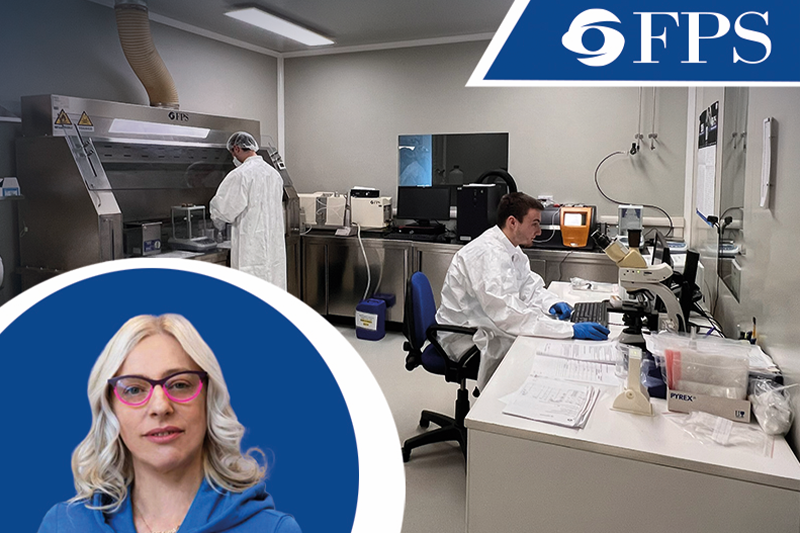
The micronisation of steroids is a technically complex and challenging process due to their intrinsic characteristics. Steroids are often hard and tend to form build-ups during processing, which can significantly reduce the effective volume of the milling chamber.
Among steroids, in my experience, fluticasone propionate is the most challenging to microns.
Why do you consider fluticasone propionate the most complex case?
Firstly, achieving proper crystal breakage requires a very high level of energy, with extremely high process-fluid pressures. Under these micronisation conditions, the crystals often tend to aggregate, forming thick, hard deposit layers that progressively reduce the effective size of the micronisation chamber. This reduction alters the gas velocity fields and thus the classification, resulting not only in an insufficient process yield but also in a shift of the particle size distribution (PSD), with a significant risk of OOS (Out-of-Specifications).
The occurrence of the latter leads to an immediate interruption of the process and to the consequences that are unfortunately well known to everyone in the sector. Moreover, fluticasone propionate is typically used, in the formulation of inhalation medicines in combination with bronchodilators. This application necessarily requires an extremely stringent PSD to ensure therapeutic efficacy.
Can you tell us about one of the typical test requests you received for this API?
Yes, I can describe one of the most recent requests. We were contacted by a major CDMO because they needed to develop a robust and repeatable micronisation process, both intra-batch and inter-batch, with minimal product consumption.
Thanks to the complete range of FPS Pharma micronisation systems, we are able to perform tests even with the smallest-size mills and with inserts made of advanced materials (I cannot disclose these details as they are part of the company’s know-how), ensuring the minimisation of product consumption and caking phenomenon. We therefore carried out the first short tests on the received fluticasone propionate sample, in order to identify the suitable operating parameters: operating pressure and feed rate. Subsequently, longer tests were performed using inserts made of different materials to evaluate the ideal solution for minimising the caking phenomenon.
Having solved the main issue, we used all the remaining product to test the process over a period of time that was long enough to define it as robust. Based on the results, since they met the client’s requirements, we performed the calculations needed to determine the parameters required for scaling up from pilot production to industrial scale. The scalability of our systems is ensured by internal studies initially based on the calculation of specific energy and validated by repeated micronisation tests carried out on jet mills of all sizes.
The analyses and the micronised samples were then delivered to the client within 48 hours, allowing them to safely and effectively replicate the process at their facility, obtaining particle size results within specification and preventing the risk of OOS.
Thank you, Federica. Can you tell us what type of mill you prefer for micronising fluticasone propionate?
The choice certainly depends on the product quantity received from the client. It is in fact possible to perform the entire analysis and test series with as little as 50 g of product, but I always recommend using spiral jet mills integrated into an isolator to ensure operator safety.
I would also like to emphasise that, given the general complexity of micronisation processes, I am always pleased to invite clients to visit the MEC and attend the execution of the tests, so that they can see exactly how to address these challenges.
D.Sc. Federica Del Matti – FPS Pharma, MEC Manager


