


Published in Science Advances, the study introduces TITO (Transferable Implicit Transfer Operators), a deep generative modelling framework that learns the statistical rules governing molecular motion directly from simulation data.
Rather than calculating atomic forces step by step — as traditional molecular dynamics requires — TITO predicts how molecules evolve with time, effectively skipping ahead through what the researchers describe as "molecular movies."
The bottleneck it addresses
Conventional molecular dynamics simulations require steps of around one femtosecond (10⁻¹⁵ seconds) to remain stable.
As the molecular processes relevant to drug development occur over much longer timescales, billions of calculation steps are typically needed, making large-scale screening computationally expensive and time-consuming.
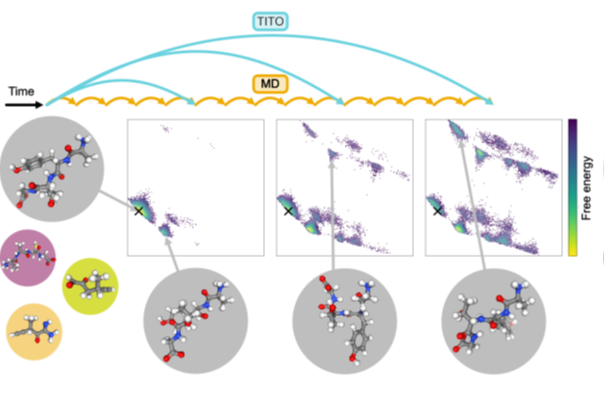
The TITO AI model learns to fast-forward in time at a faster rate than conventional numerical simulations, enabling researchers to characterise the physical properties of molecules more quickly
TITO bypasses this by learning underlying dynamics from short simulation sequences — spanning tens of nanoseconds — and then predicting molecular behaviour in timescales a thousand times longer, without having seen those processes during training.
Scope of the study
The model was trained and validated against more than 12,500 organic molecules, including carbon, nitrogen, hydrogen and oxygen-containing compounds, as well as more than 1000 short peptides.
Results were cross-checked against established numerical algorithms and found to be consistent with known physics.
Crucially, the model generalises: it applies successfully to molecules it has never encountered, having learnt broad rules of molecular motion rather than memorising specific systems.
Industry relevance
For manufacturing chemists involved in early-stage formulation or API candidate screening, the implications are practical.
Faster, reliable simulation of how molecules transition between conformations — and the pathways and rates of those transitions — could reduce the number of physical tests required before shortlisting candidates.
Juan Viguera Diez, industrial doctoral student at AstraZeneca and lead author, noted strong industry interest in simulations that better reflect physical reality.
The model is currently validated on small molecular systems under simplified conditions.
Further development for more complex, realistic environments is ongoing, with the research team positioning TITO as a platform for broader applications in pharmaceutical and chemical R&D.


