Ask any pharmaceutical manufacturer where they go to find out how their equipment is performing, when their next maintenance is due or why an alarm just triggered on the production line and you’ll often get the same answer: it depends. A spec sheet lives in one inbox, a service report in another, historical batch data is buried in a plant historian and the number for the right support contact is scribbled on a whiteboard somewhere. The information exists … but it's scattered.
That fragmentation is the problem GEA is trying to address, according to Dietrich Mertens, Head of Digitalisation for GEA's Pharma business unit. "There's a lot of equipment- and machine-related data that we share with our customers, but there isn’t a single repository for that information. It doesn’t all sit in one place," he explains. The response is not a single app or a one-off tool, but a connected set of digital products, each aimed at a specific point of friction in day-to-day production, maintenance and service workflows.
At a glance: what's available today and what's coming
|
|
|
|
|
|
|
|
|
|
|
|
|
|
|
|
|
|
|
|
|
|
|
|
One portal, three everyday use cases
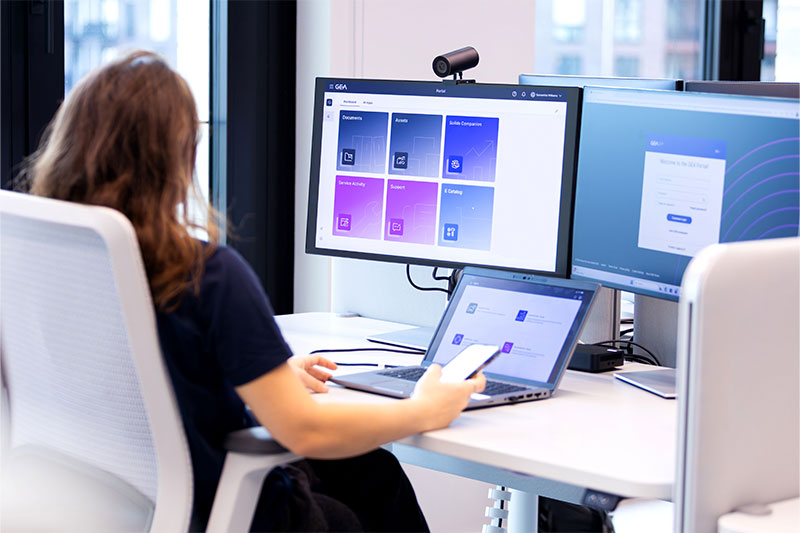
The foundation is the GEA Portal, which is now included as standard with every new machine that GEA sells. For equipment owners, that means no separate licence to negotiate and no extra cost; connectivity comes built in from day one. Inside the Portal, three core applications are already live and address common service and information needs.
- The Support App turns the old-fashioned back-and-forth exchange of emails and phone calls into a simple structured request. You can raise a service question, ask for training or flag a maintenance issue at any time, from anywhere, and then track exactly where that request stands. Every ticket's status is visible: what's been done, what's still outstanding and what, if anything, is needed from your side next. Nobody has to chase an update by email or wonder whether a request was picked up at all.
- The Document App replaces the all-too-familiar scramble through shared drives and email chains with a single searchable home for technical information, including datasheets, operating manuals, drawings, spare parts lists and critical alarm references. If it's about the machine, it's here and it is current.
- The Asset App gives a single, centralised view of everything about the equipment itself: when it was built, warranty status and other core machine data, without needing to dig through paperwork or call GEA to ask.
Taken together, the three applications are intended to reduce time spent searching for information or following up on service requests. For engineers, the practical value is having a clearer first place to look before a small question becomes a delay.

Making spare parts simple: the E-Catalogue
Sitting alongside the Portal and now live for all new equipment is the E-Catalogue. Rather than hunting through PDF parts lists to identify the right component, you can navigate an interactive 3D model of your actual machine, click into specific assemblies, select the part you need and request a quote — all inside the same Portal experience. The aim is straightforward: reduce the risk of selecting the wrong part number and cut down the clarification needed before a replacement can be ordered.
Solids Companion: turning machine data into decision support
Solids Companion is the next layer in that approach. Currently in development, with a first evaluation version targeted by Q2 2027 and a full commercial release by the end of that year, it is designed to turn a plant's own historical machine data into guidance that can support production decisions.
Access is through a secure, cloud-based interface that’s available 24/7 via a web browser, including remotely. Rather than being tied to a single machine or plant, users see a list of their installed assets. These might span a range of technologies and multiple locations, but the system enables a team responsible for more than one site to work from one view rather than several.
Mertens describes it as one of the more advanced products currently in the pipeline. Its three core areas answer questions that production and quality teams ask regularly.
Visibility and performance made comparable: Instead of manually pulling data from multiple systems, production teams get a unified view of process performance (such as recipe settings, trends and critical-to-quality statistics), all presented together. Crucially, the tool doesn't just show data in isolation; it allows batches to be benchmarked against each other and compared with a "reference batch." With time, therefore, you can see whether performance is improving, drifting or holding steady and get concrete, data-backed recommendations for set-point changes on future batches.
Faster context when something goes wrong: The Alarm Analysis section lays out alarms and warnings along a process timeline; so, instead of scrolling through logs, you can see when and where an issue occurred. Solids Companion then adds likely root causes and suggested corrective actions for each alarm, turning part of the diagnostic work into a more guided troubleshooting step. Alongside the alarm timeline, the tool offers the ability to drill down into specific downtime issues: not just “what triggered the alarm?” but "where did the time go?"
Maintenance that's planned, not reactive: The Service section provides a simple, prioritised summary of maintenance needs across the installed base (what's due, what's overdue, and how critical each item is), so teams can act before a small issue becomes a costly failure. The result is planned rather than reactive intervention and a lower cost of ownership, driven by better timing rather than guesswork. The reporting is deliberately simple and concise, with a clear indication of critical and overdue items, and it can be configured so that teams focus on the actions that matter most to them.
Development is currently focused on continuous processing lines, with an equivalent product for batch equipment planned to follow. As Mertens puts it, the ambition is for Solids Companion to become the layer that doesn't just report what happened but helps teams decide what to investigate or adjust next.
Building toward the future
Two further developments show where the ecosystem is headed. Digital Name Plates — currently piloting on tablet presses, with rollout to further pharmaceutical equipment ranges this year — replace the traditional metal nameplate with a QR code linking to a landing page of basic equipment information. Users with portal access can move straight from that page into the full Portal experience. It's a small step, but a deliberate one: it's the first stage toward the Digital Product Passport, a requirement the EU is expected to introduce for manufacturers in the coming years. In addition, an AI-based assistant, a "copilot" for the Portal itself, is in development to help users search and interpret their own documentation more easily. Importantly for security, it will draw only on information the user is already entitled to see, which is held within GEA's secure, certified cloud environment; it cannot reach beyond those permissions.
The bigger picture
Seen together, these products point to a broader shift in how equipment information could be used after installation. The Portal and E-Catalogue focus on access: finding documents, service support and spare parts more easily. Solids Companion moves further into interpretation by using process and maintenance data to support better-informed production decisions. For pharmaceutical facilities, the question is no longer only whether the data exists. It is whether production, maintenance and quality teams can access it quickly enough — and in a useful enough form — to act before small issues become bigger ones.
GEA Digital Solutions for Pharma Manufacturing