
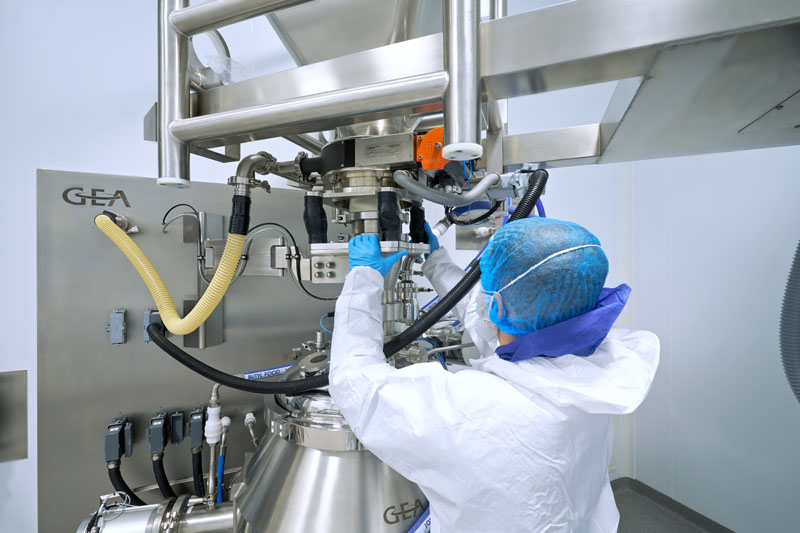
Dry granulation by roller compaction is now a mainstream option in oral solid dose (OSD) development and manufacture.
Widely used for moisture- and heat-sensitive active pharmaceutical ingredients (APIs) and poorly flowing blends, it offers an alternative when direct compression or wet granulation is unsuitable.
The global market for pharmaceutical continuous manufacturing is projected to grow from $1.5 billion in 2024 to more than $3 billion by the early 2030s, reflecting sustained double‑digit annual growth as the industry shifts from batch to continuous production.1
Within that shift, dry granulation by roller compaction is a key enabler for OSD lines based on continuous processing.
Roller compaction densifies powders without added liquid, generates granules with improved flow and removes the need for drying.
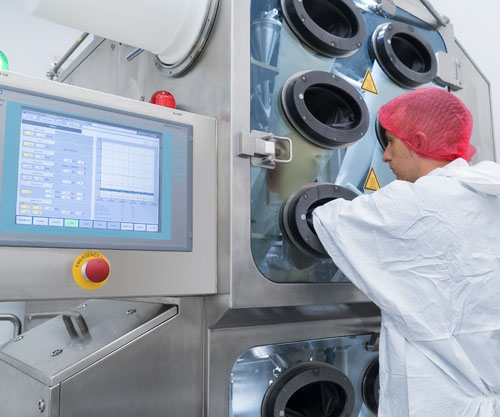
These features simplify process design while maintaining the stability of APIs that are susceptible to hydrolysis, thermal degradation or solid-state change.
They also align with broader priorities such as Quality by Design (QbD), containment for highly potent compounds and the increased adoption of continuous manufacturing.
Process fundamentals
Roller compaction converts a powder blend into a compacted ribbon that is then broken down into granules with a defined size range for tablet compression, capsule filling or sachet packing.
Material is metered from a hopper into a screw feeder or similar device that delivers a consistent, deaerated powder stream to the nip between two counter-rotating rollers.
In the nip, particles rearrange under stress, deform and form interparticle bonds to produce a coherent ribbon. That ribbon is processed in a milling step during which screen opening, rotor speed and mill geometry dictate the balance between target granules, fines and oversized fragments.
Although the flowsheet looks simple, performance is highly sensitive to feed consistency, compaction conditions and milling intensity because they each influence granule structure and, ultimately, dosage form behaviour.
Compared with slugging, roller compaction is generally more consistent and scalable. Unlike wet granulation, it avoids liquid addition and drying, reducing equipment demands and the risk of stability-related issues.
Dominant variables and QbD
Development teams focus on three primary process variables: specific compaction force, roller gap and roller speed.
A specific compaction force governs densification and ribbon strength. If the applied force is too low, ribbons are fragile and generate excessive fines; if it is too high, material can be over-compacted and show impaired tabletability during recompression.
Roller gap and speed are similarly influential. The gap between the rollers affects dwell time under load and ribbon thickness; narrower gaps generally promote higher densification but increase stress.

Roller speed influences throughput and the time particles spend under compression: higher speeds may increase output yet reduce dwell time, subsequently changing ribbon morphology.
These parameters interact with feed rate and material compressibility, so process understanding requires structured experimentation. This interplay makes roller compaction well suited to QbD-driven development.
Design of experiments can be used to map relationships between compaction forces, gap settings, speeds, ribbon attributes, granule size distributions and tablet performance.
The resulting knowledge supports the definition of a rational design space and a control strategy matched to product risk.
The role of milling
Once a ribbon has been formed, milling can either preserve or undermine the benefits of compaction. Overly aggressive conditions increase fines, broaden the granule size distribution and damage granule microstructure, all of which can compromise downstream performance.
Gentle oscillating mills are often preferred because they can deliver a narrower size distribution and limit attrition compared with more intense technologies.
Granule size distribution directly influences die filling, segregation tendencies, blend uniformity and the robustness of tablet compression or capsule filling.
Milling parameters should therefore be treated as core process variables and optimised alongside compaction conditions.
Equipment architecture and control
Roller compactor design has a clear impact on consistency. Pharmaceutical machines are commonly built as fixed-gap or floating-gap systems.
In fixed-gap designs, the roller separation is held constant, so changes in feed or material behaviour appear as variations in compaction force. Floating-gap systems allow the roller distance to adjust to maintain a more constant specific compaction force.
This can stabilise ribbon density, reduce variability in granule quality and simplify scale-up for formulations with variable flow behaviour, compressibility or air retention.
Better control of compaction force is particularly valuable when working with multicomponent blends or highly potent APIs that demand tight process control and reliable containment.
Integration into continuous manufacturing Roller compaction fits naturally into continuous manufacturing strategies. It can be incorporated into integrated lines that combine feeding, blending, compaction, milling and tableting.
Well-designed continuous processes that use advanced control techniques within a QbD framework are now actively supported by regulators.
The benefits of continuous operation, however, depend on implementation. Continuous roller compaction requires a robust control strategy that considers residence time, disturbance rejection, material traceability and, when appropriate, real-time monitoring or feed‑forward control.
When these aspects are addressed early, the same process platform can often be translated from development to commercial manufacture by extending run times rather than redesigning the route around different unit operations.
Containment and potent APIs
The growing prevalence of highly potent APIs has increased demand for processing routes that minimise open handling and reduce unit operations.
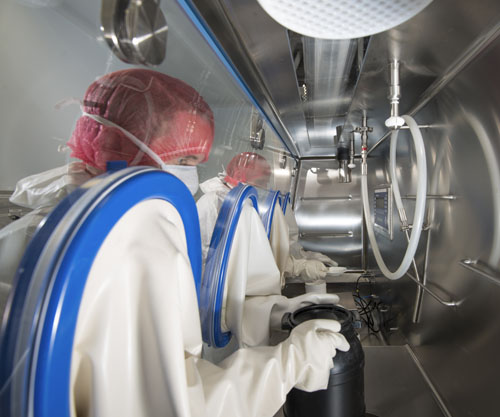
Roller compaction offers advantages because it is a dry, enclosed process that can be coupled with contained feeding, sealed transfer and closed milling solutions.
Development strategy and material behaviour
From a formulation perspective, a key question is whether the material can withstand densification stresses without losing its ability to form robust tablets.
Some excipients and APIs tolerate roller compaction well, whereas others show work-hardening that reduces compactibility in the final dosage form.
Development work needs to examine not only granule quality but also how compaction history influences tablet properties.
A typical programme begins with route selection and material characterisation.
If direct compression is ruled out and wet granulation presents stability risks, roller compaction becomes an obvious candidate.
Early studies establish feasible ranges for compaction force, gap and speed; they also screen excipient systems that support ribbon formation and satisfactory downstream compression.
As understanding develops, attention turns to defining a design space that’s underpinned, when feasible, by in-process measurements and an appropriate control strategy.
Linking ribbon density, granule size distribution and fines fraction to tablet properties, such as hardness, friability, disintegration and dissolution, is essential.
Roller compaction must be assessed in the context of the finished dosage form rather than solely on intermediate granule metrics.
Outlook for roller compaction
Given the scale of the OSD sector, even a modest fraction of products requiring dry granulation represents a significant technical demand.
Roller compaction is now widely regarded as the predominant pharmaceutical dry granulation method and a preferred route for moisture- and heat-sensitive products, as well as those designed for continuous manufacture.
Its significance for scientists and engineers lies in the combination of practical utility and strategic alignment. It improves powder handling, avoids liquid addition, supports containment and continuous processing, and scales effectively when carefully developed.
As OSD products continue to dominate the pharmaceutical landscape, roller compaction will likely remain an essential option in the development toolkit, particularly for formulations that challenge conventional wet processing.