
Manufacturing has reached extraordinary levels of automation and connectivity. Machines generate vast amounts of data, production plants are increasingly interconnected, and digital technologies have become an integral part of industrial operations. Today, the challenge is no longer collecting information but transforming it into actionable knowledge that can improve day-to-day operations.
This is the vision behind Cognitive Manufacturing, IMA’s approach to the next evolution of industrial production. If Industry 4.0 connected machines, Cognitive Manufacturing connects data, knowledge, and decision-making capabilities. The objective is to create an ecosystem in which data, artificial intelligence, and human expertise work together to make information immediately accessible and actionable across manufacturing processes.
In this model, data generated by machines, production lines, and facilities is contextualized and analyzed by artificial intelligence to provide operational guidance for operators, technicians, and production managers. When an anomaly occurs, for example, the system can identify correlations, suggest potential root causes, and guide troubleshooting activities based on knowledge and experience accumulated throughout the organization.
The result is faster and more consistent decision-making, delivering tangible benefits such as reduced downtime, increased production efficiency, improved quality, and greater operational continuity.
DISTRIBUTED ARCHITECTURE
To enable this approach, IMA has developed a distributed intelligence architecture in which cognitive capabilities operate at multiple levels of the production system.
At the center of the ecosystem is IMA INTELLECTA™, IMA’s Generative Artificial Intelligence platform, which acts as the brain of the Cognitive Manufacturing system. By coordinating and correlating data from machines, production lines, and manufacturing sites, INTELLECTA™ builds a real-time understanding of production activities and makes operational knowledge and recommendations available across the organization. This enables manufacturers to identify recurring patterns among seemingly unrelated anomalies, recognize the root causes of downtime more quickly, and recommend corrective actions based on cases previously encountered on other machines, lines, or departments—effectively making INTELLECTA™ a digital coach for operators working on the shop floor.
Intelligence, however, is not confined to the cloud. Through AI on Edge solutions, similar cognitive capabilities are deployed directly on machines, where they support operators and maintenance personnel in their daily activities.
Among these applications are Generative AI-Powered Troubleshooting systems, which transform technical manuals, service documentation, and company know-how into real-time operational assistance. Directly from the HMI, operators can receive voice or text guidance, access step-by-step procedures, automatically retrieve relevant documentation, and obtain recommendations on the best actions to resolve issues and minimise downtime.
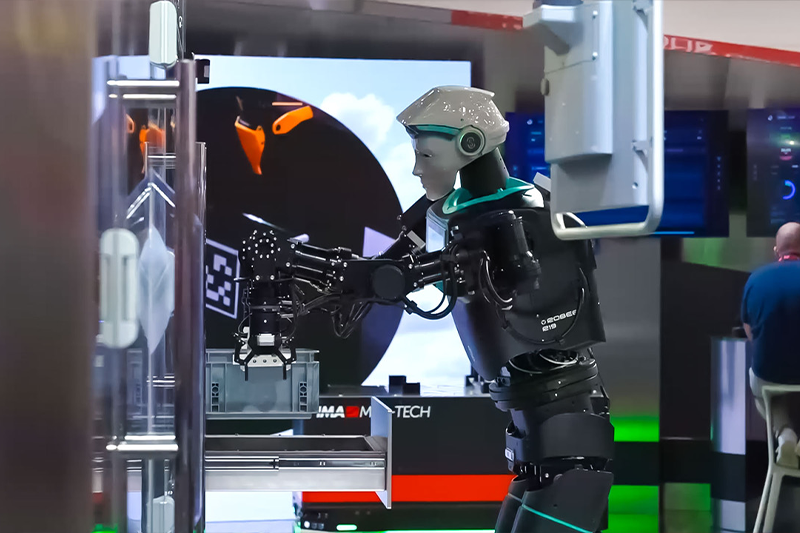
Robotics is also an integral part of this cognitive architecture. Coordinated by INTELLECTA™, robots operate not as isolated automation units, but as components of an integrated system capable of adapting operational behaviors according to production conditions, line status, and process objectives, improving efficiency, safety, and process consistency.
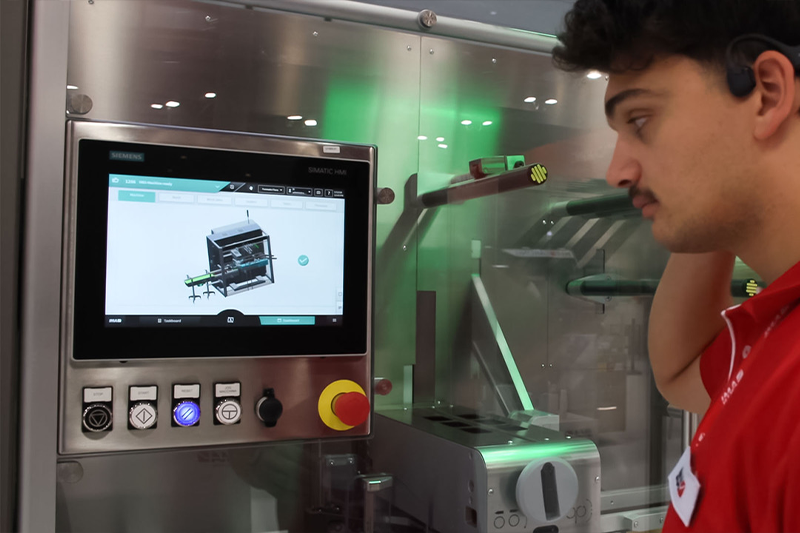
In this forward-looking model, which IMA proposes as the next evolution of industrial production, artificial intelligence continuously supports the management and optimization of manufacturing processes, while people retain operational oversight and decision-making responsibility. When unexpected situations arise, operators and technicians are supported by AI, which immediately provides contextualized data, similar historical cases, technical documentation, and recommended corrective actions. The goal is not to replace human expertise, but to enable people to understand and solve problems more quickly.
This vision was brought to life at Interpack 2026 in Düsseldorf, where IMA demonstrated how AI, data, robotics, and connected systems can already collaborate within a single production environment. The showcased applications highlighted how Cognitive Manufacturing can support people in their daily activities, accelerate problem resolution, and continuously improve operational performance.
With Cognitive Manufacturing, IMA introduces a new perspective for industry: a factory where artificial intelligence coordinates information and processes, machines and robots execute and learn, and people have the tools they need to make better decisions, faster.
Because the next challenge for manufacturing is not increasing automation. It is putting the right knowledge into the hands of the right people, exactly when they need it.
Find out more: https://imagroup.com/step-into-cognitive-manufacturing/


