Rowan University has teamed with Pfizer Global Engineering on ways to make drug production greener
Rowan University faculty and students have teamed with Pfizer Global Engineering (PGE) and Manufacturing personnel to investigate green approaches to drug manufacture.
The team has collaborated on analyzing the economic viability and quantifying the environmental benefits of investing in a small solvent recovery system, as an alternative to incineration, for addressing smaller-volume waste streams. Solvents often represent the primary component of waste from the production of active pharmaceutical ingredients (APIs), used in medicinal formulations
This is the second time Rowan has partnered with Pfizer to investigate methods to reduce the carbon footprint of pharmaceutical plant operations. This year, the Rowan team has worked with scientists and engineers from Peapack, New Jersey (NJ), and the Kalamazoo, Michigan, plant where drugs, such as the widely prescribed Solu-Medrol, are made along with other highly specialised medicines.
The Rowan team has been working with several Pfizer personnel, including Frank Urbanski (director, Pfizer Global Engineering), Joseph Geiger (manager API engineering), and Donald Knoechel (senior principal scientist).
PGE director Urbanski explained the need for such a project: ‘There are economic and environmental benefits when Pfizer recovers solvent for re-use, especially when expensive solvents and large volumes are involved. Indeed, Pfizer has been recovering solvents for many decades at its various manufacturing facilities. As we seek to improve our conservation efforts and reduce our carbon footprint, one challenge faced is how best to deal with numerous small-volume waste streams from multi-product facilities, when existing solvent recovery equipment may be too large to be practical.’
Solvent recovery is a routine practice in the pharmaceutical industry when it is technically and economically viable for the particular waste stream. Capital investment in the required piping, tank farms and recovery equipment is more easily justified when dealing with large volumes, high-cost solvents and high equipment utilisation rates and when solvents from multiple products can be pooled together – i.e., they don’t require segregation by product.
The use of recovered solvents, and the pooling of solvents, must be appropriately qualified to assure product quality and avoid cross contamination.
Economic justification to recover small-volume, “non-poolable,” and intermittently generated waste streams remains challenging but a potential recovery opportunity.
Dr Mariano Savelski and Dr Stewart Slater, both Rowan chemical engineering professors, are leading this research effort with a team of chemical engineering students: Joseph Hankins, Christopher Mazurek, James Peterson, Michael Raymond, and Andrew Tomaino.
The Rowan team performed a case study on several waste streams being generated at an API synthesis building at the Pfizer Kalamazoo plant. The goal was to investigate those streams that could be most easily recovered with traditional separation and purification processes. As a first step in that analysis, the recovery of acetonitrile solvent from a waste stream in the selamectin synthesis was considered. Selamectin is the active ingredient in the veterinary drug called Revolution. This stream was initially chosen due to the relative high cost (and value) of acetonitrile and the ability to separate acetonitrile from acetone.
Rowan designed a small-scale distillation, solvent-recovery system, and the proposed operation compared with the current waste-disposal practice. To increase the economic feasibility of a potential capital investment and improve the environmental footprint further, the Rowan team evaluated the proposed design for use with the other waste streams in the facility. The simulation included isopropanol solvent recovery from the manufacture of nelfinavir, the active ingredient in the antiretroviral drug Viracept, used in the treatment of the human immunodeficiency virus (HIV). The study also examined toluene recovery from hydrocortisone manufacture (used in several drug products for relief of inflammation).
‘The case study estimates the environmental impacts and economics, using life-cycle assessment, associated with the proposed improvement using various computer routines,’ Savelski said.
Knoechel said: ‘From a plant perspective, the Rowan team has given us some valuable estimates to use in evaluating our solvent use and disposal practices. The team’s unique life-cycle assessment capability helps us understand where we can have the most impact on reducing our greenhouse gas emissions.’
The case study for the three drugs showed that 732,000 kg/yr of life cycle emissions, of which 677,000 kg/yr are CO2, could be reduced through using the solvent recovery system. This results from not having to manufacture the virgin solvent as well as from a reduction in waste disposal. The study also projects significant operating cost benefit. The CO2 reductions are equivalent to the amount of emissions saved by not driving cars 1.4 million miles in a year.
The Rowan group presented its work at the 14th Green Chemistry and Engineering Conference in Washington, D.C., in June.
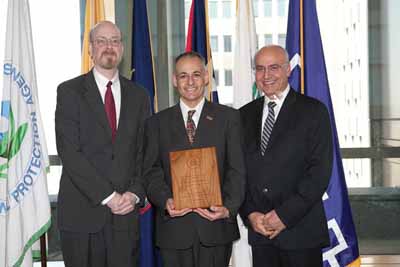
Both Pfizer and Rowan recently have been recognized for their green chemistry and engineering achievements. Pfizer’s La Jolla (Calif.) research and development facility won a Clean Air Champions award from the County of San Diego in 2009. Rowan’s Savelski and Slater won the EPA’s Environmental Quality Award in 2009 for their efforts in educating both academia and industry in the field of green engineering. Rowan University’s prior work with Pfizer resulted in recommendations to improve the solvent-recovery operations in the manufacture of celecoxib, the active ingredient in the arthritis pain medication Celebrex.
Pfizer and Rowan continue to discuss further green engineering partnerships.