
The hazard that was already on file
On 29 January 2003, an explosion tore through the West Pharmaceutical Services plant in Kinston, North Carolina, killing six workers and injuring dozens more. The fuel was a fine polyethylene powder from the plant's coating process. Over years it had drifted through air intakes and settled, unseen, in the void above a suspended ceiling.
Investigators later found the company's own files had flagged the powder as combustible. The danger was known. What was missing was any recognition that the space above that ceiling was somewhere an explosive atmosphere could form.
That gap has a name in European practice: a failure of area classification. It is the first thing ATEX asks a manufacturer to get right, and everything else depends on it.
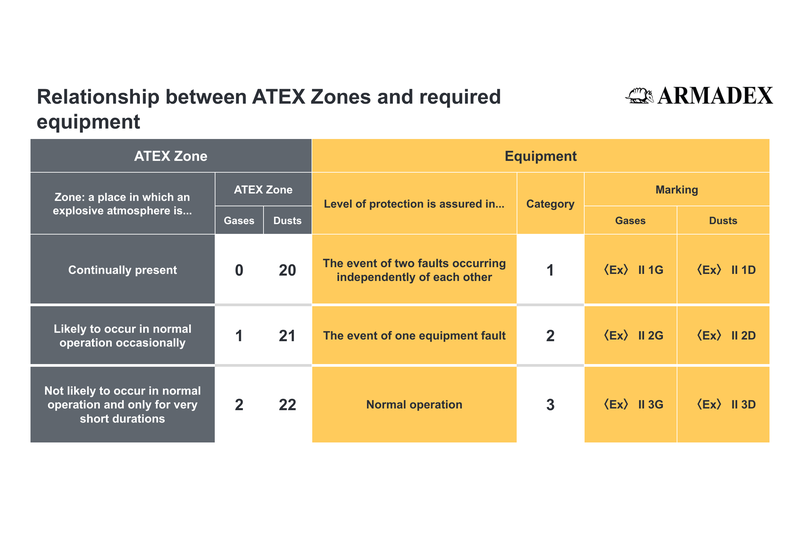
Under DSEAR and the ATEX framework, a site is assessed to establish where a hazardous atmosphere can occur, and how often, before any equipment is specified.
Where the hazard is a gas, vapour or mist, the area is graded Zone 0, 1 or 2. Where it is combustible dust, the equivalents are Zone 20, 21 and 22. The thresholds are concrete: a Zone 0 atmosphere is present for more than 1,000 hours a year, a Zone 1 for between 10 and 1,000 hours, and a Zone 2 for less than 10. The dust zones follow the same logic of continuous, occasional and unlikely.
The classification is not academic. It sets the category of equipment allowed in each space, from motors and lighting to cameras and instrumentation, all of which must be built so they cannot ignite the atmosphere around them. It also has to reckon with the material. Fine powders ignite far more readily than their bulk suggests, and it is the finest fraction, the part that drifts and settles like the polyethylene at Kinston, that governs the hazard.
Two mistakes recur. Classify too cautiously and a plant pays for protection it never needed. Overlook a space entirely and ordinary equipment ends up in an atmosphere it was never designed to survive. Kinston was the second kind: a whole volume no one had thought to assess.
Nor is classification a one-off. A new solvent, a higher throughput or a modified layout can move the boundaries of a zone, which is why it should be revisited whenever a process changes rather than filed and forgotten.
For anyone responsible for safety in chemical or pharmaceutical manufacturing, the lesson is simple. Knowing a substance is dangerous is not enough. Area classification is what turns that knowledge into a map of where the risk truly lies, and it is the foundation the rest of the ATEX regime is built on.
Visit us at https://armadex.com/


