
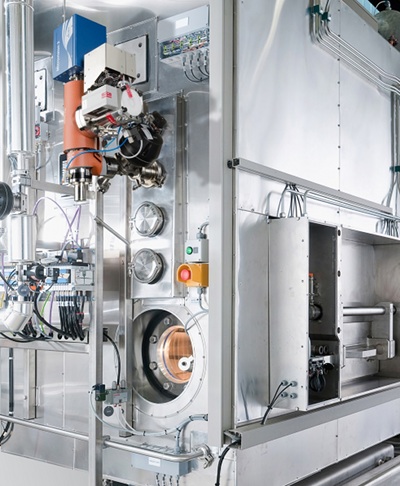
A leading pharmaceutical company has been evaluating GEA Lyophil’s Lyoplus mass spectrometer to provide essential data from within the freeze dryer itself.
The unnamed company has confirmed a number of benefits, including the ability to detect very small silicone oil leaks inside the dryer; the ability to monitor the moisture content within the freeze drying chamber; identifying the end point of primary and secondary drying; and a much easier and faster leak detection.
The pharmaceutical company is already operating a Lyoplus system and will shortly have it fitted to five additional freeze dryers. By the end of 2012 it expects to have more systems in operation.
Lyoplus is able to work alongside any existing PLC/SCADA system as a stand-alone unit or fully integrated within the control system. It can also be operated independently as a monitoring system that does not interfere with any qualified processes.
GEA Lyophil says Lyoplus performs three tests – silicone oil detection, moisture content and chamber leakage – in one single unit, thereby improving productivity; reducing power consumption and the environmental impact of the process; and saving time and money.
Lyoplus performs three tasks in one unit
Improving productivity and reducing environmental impact

You may also like
Manufacturing
![From Indonesia to the world: support Beta Pharmacon’s manufacturing excellence with GEA granulation technology]()

From Indonesia to the world: support Beta Pharmacon’s manufacturing excellence with GEA granulation technology
Read moreBy integrating GEA granulation technology into its new facility, Beta Pharmacon has enhanced process control, reinforced its commitment to regulatory compliance, and secured GMP and USP qualifications to supply essential micronutrient supplements
Trending Articles
Relevant companies
You may also like
Manufacturing
![From Indonesia to the world: support Beta Pharmacon’s manufacturing excellence with GEA granulation technology]()
From Indonesia to the world: support Beta Pharmacon’s manufacturing excellence with GEA granulation technology
By integrating GEA granulation technology into its new facility, Beta Pharmacon has enhanced process control, reinforced its commitment to regulatory compliance, and secured GMP and USP qualifications to supply essential micronutrient supplements
Manufacturing
![Safety in pharmaceutical manufacturing: why a trusted partner makes all the difference]()

Safety in pharmaceutical manufacturing: why a trusted partner makes all the difference
By taking a three-tiered approach to protecting patients and personnel and ensuring plant compliance, GEA adopts a consultative approach to helping its customers navigate the responsibilities of pharmaceutical manufacturing safety with confidence
Manufacturing
![Simplifying continuous operations: lowering the barrier to faster development]()

Simplifying continuous operations: lowering the barrier to faster development
Continuous manufacturing has long promised faster development, improved process understanding and, in the absence of scale-up, smoother commercialization. For many pharmaceutical R&D teams, those benefits are well understood. What still holds them back, however, is not scepticism about the concept; it’s the perceived effort required to implement it
Design & Build
![ESTEVE CDMO expands spray drying and high-potency containment capacity at Girona facility]()

ESTEVE CDMO expands spray drying and high-potency containment capacity at Girona facility
ESTEVE CDMO has announced plans to add a 3000-square-metre production unit at its Celrà site in Spain to house additional spray drying equipment and high-potency containment suites, with the first new GEA spray dryer due online in Q1 2027
Manufacturing
![Mastering precision: overcoming production hurdles for inhalable dry powder manufacturing]()

Mastering precision: overcoming production hurdles for inhalable dry powder manufacturing
From high-shear blending mechanics to the impact of particle size and distribution, this article explores the key factors that define effective inhalable powder formulations and how innovative processing methods are enhancing stability, performance and scalability

Manufacturing
![Drug-loaded pellets: unlocking flexible oral dosage design with modern pelletisation technologies]()

Drug-loaded pellets: unlocking flexible oral dosage design with modern pelletisation technologies
Produced using advanced extrusion–spheronisation technologies such as GEA’s NICA systems, drug-loaded pellets are gaining traction as a flexible and scalable oral solid dosage platform that enhances release control, patient outcomes and manufacturing efficiency